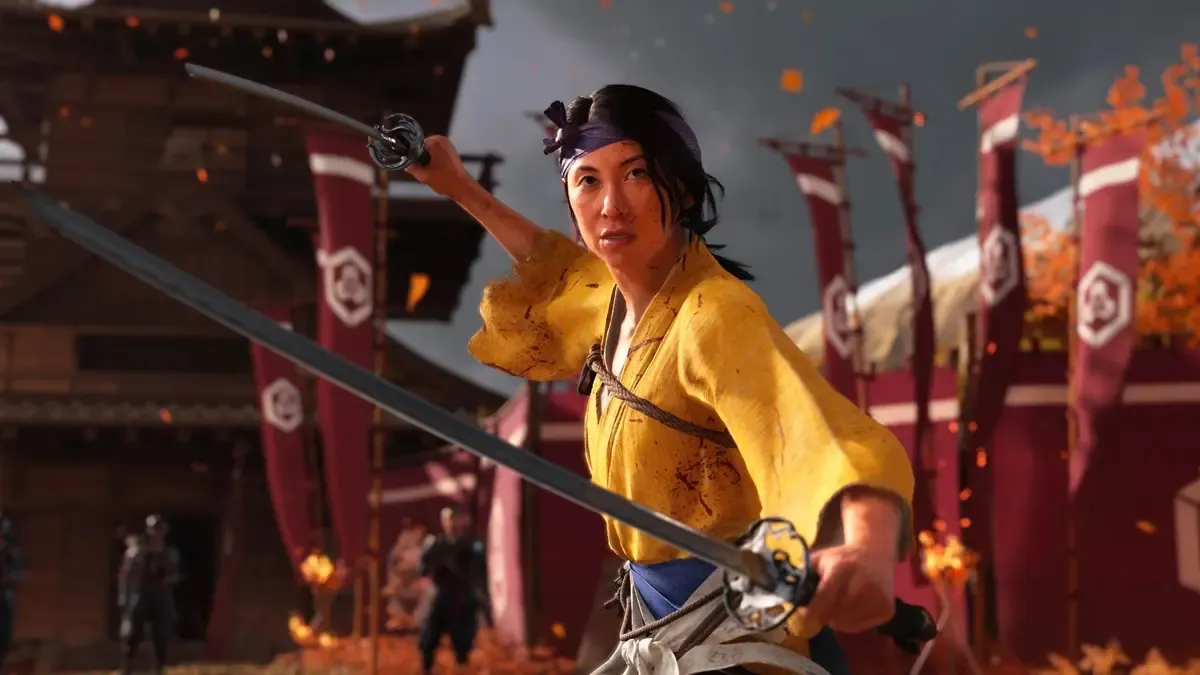
Atsu's hunt for her family's killers begins in Ghost of Yōtei.
Sucker Punch Productions’ open-world action-RPG Ghost of Tsushima is finally getting a sequel in Ghost of Yōtei, though this new entry sees the developer start from scratch in more than one way. Instead of continuing the adventures of Jin Sakai following his journey across Tsushima Island, Ghost of Yōtei chooses to root its story in unfamiliar territory. Its protagonist Atsu is a fresh face, and her home of Ezo houses new sights, warring factions, and threats aplenty.
Thankfully, Ghost of Yōtei shakes things up for the better. Its open world is as immersive as it is addictive to explore, and its side quests finally boast the level of diversity that players yearned for in the original game. While the main story is a little more hit-or-miss in execution, Sucker Punch has managed to craft an experience that not only lives up to Ghost of Tsushima, but surpasses it.
Atsu’s hunt for the Yōtei Six begins
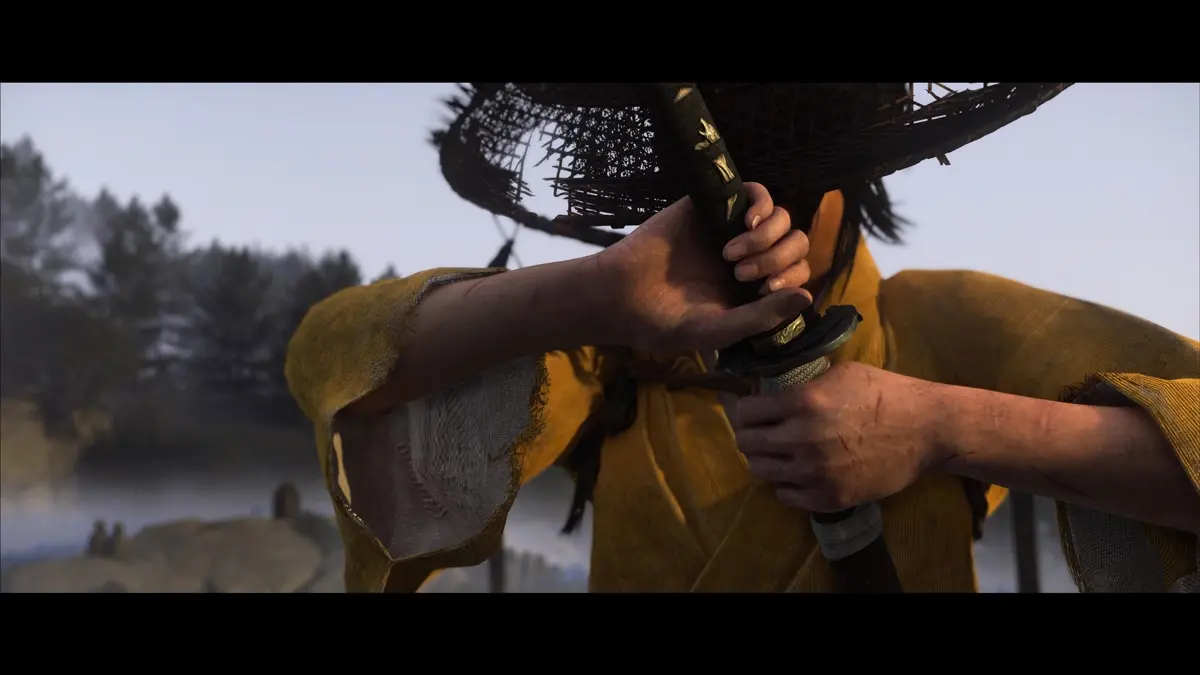
Ghost of Yōtei cements this franchise as an anthology, picking things up more than 300 years after the events of Ghost of Tsushima. Players follow new protagonist Atsu, a mercenary who left Ezo after her family was brutally murdered by a group of clan leaders looking to claim power over the land. This group is known as the Yōtei Six, comprising the Snake, Oni, Kitsune, Dragon, Spider, and their leader Lord Saitō.
Players are dropped into the thick of Atsu’s revenge story, with the story beginning in earnest many years after she left home to undergo training as a mercenary. Armed with new combat skills, Atsu is looking to celebrate her homecoming by crossing each member of the Yōtei Six off her list violently, though the odds are not leaning in her favour. Ezo is in the midst of a struggle for power between the Matsumae clan’s samurai and Lord Saitō’s seemingly infinite outlaws, the latter of whom are led by the Yōtei Six themselves.
Having lost her family, Atsu has forcefully stripped herself of humanity to become a ghost. However, her hunt gets increasingly more complex as she realises that there’s more to these barbarians than meets the eye. Her connections with the people of Ezo grow, and her understanding of the two warring clans at play deepens, and thus she has to grapple with the fact that there might be more to life than all this blood and chaos.
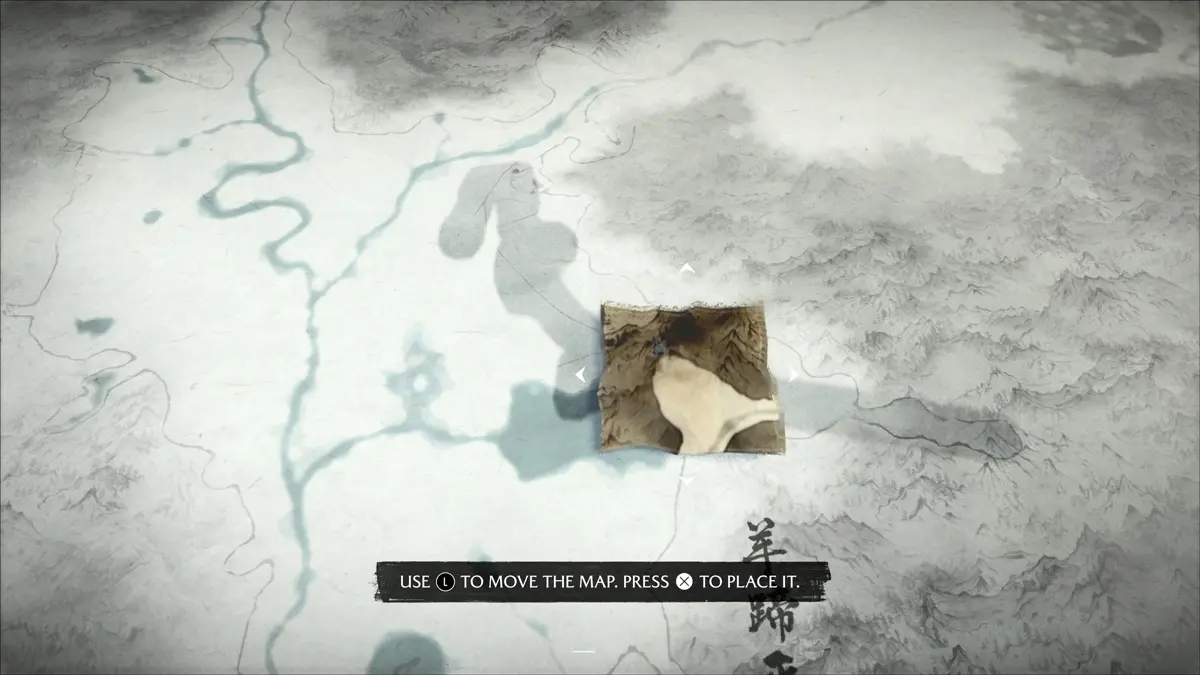
This conflict drives Atsu’s story, and ultimately lends it the substance it sorely needs. In the game’s early hours, her hunt for the Yōtei Six comes across as a shockingly by-the-numbers revenge story. With so little context on Atsu’s motivations save for a quick prologue cutscene and borderline generic antagonists to start with, players might have difficulty buying into her burning desire for revenge. However, as drip-fed flashbacks peel back the layers of what happened that night, they’ll understand where all that anger comes from.
Erika Ishii (Dimension 20, Dropout)’s performance as Atsu is as layered as the character deserves, steadily growing more vulnerable and empathetic as the wolf pack expands in number. The rest of the main cast feels much more memorable than Tsushima’s as well, with even in-game vendors having lots of personality and history to uncover. Thankfully, Yōtei also rights another one of Tsushima’s wrongs with a fully lip-synced Japanese dub at launch. As a Dropout fan, I stuck with the English dub for the most part–but it should go without saying that Fairouz Ai's performance as Atsu is great as well.
While Atsu’s journey eventually picks up speed, I didn’t find myself nearly as invested in her revenge quest as I wanted to be. Part of that might come down to the opening stretch feeling so stale, but I do feel like the story could have done much more with the Yōtei Six themselves. The game fleshes a few of them out enough to keep them relevant throughout the story, but the main antagonist himself, Lord Saitō, simply does not hold a candle to Tsushima’s Khotun Khan. He is neither fearsome nor cunning, surrounding himself with unimaginably poor choices of right-hand-men with lofty plans to take over an entire island.
That being said, a few of the Yōtei Six hunts do offer compelling stories that further Atsu's personal journey, with the Kitsune in particular taking this story in a direction I didn't quite expect.
Atsu's ever-expanding arsenal of weaponry

Ghost of Yōtei takes an “if it ain’t broke, don’t fix it” approach to combat, and that really isn't a bad thing at all. Much like Jin, Atsu fights like both a samurai and an onryō–sneaking up on rooftops in the shadows or initiating a duel to meet her enemies head-on. Timing your parries and dodges becomes increasingly important as the story progresses, and Ezo becomes a more dangerous place for Atsu to be. Thankfully, she still has a collection of tools, ranging from kunai to smoke bombs, to keep threats at an arm’s length.
This is not to say that Yōtei has not made any improvements to Tsushima’s combat system, however. Players are now able to disarm their enemies via a skill tree ability. Consequently, enemies can also disarm Atsu with a special attack that flashes yellow, which leaves her scrambling for her katana while getting mobbed by enemies. This addition can make some of the late game’s enemy encounters even more challenging than the previous game, as players now have to keep track of more special moves to counter in combat.
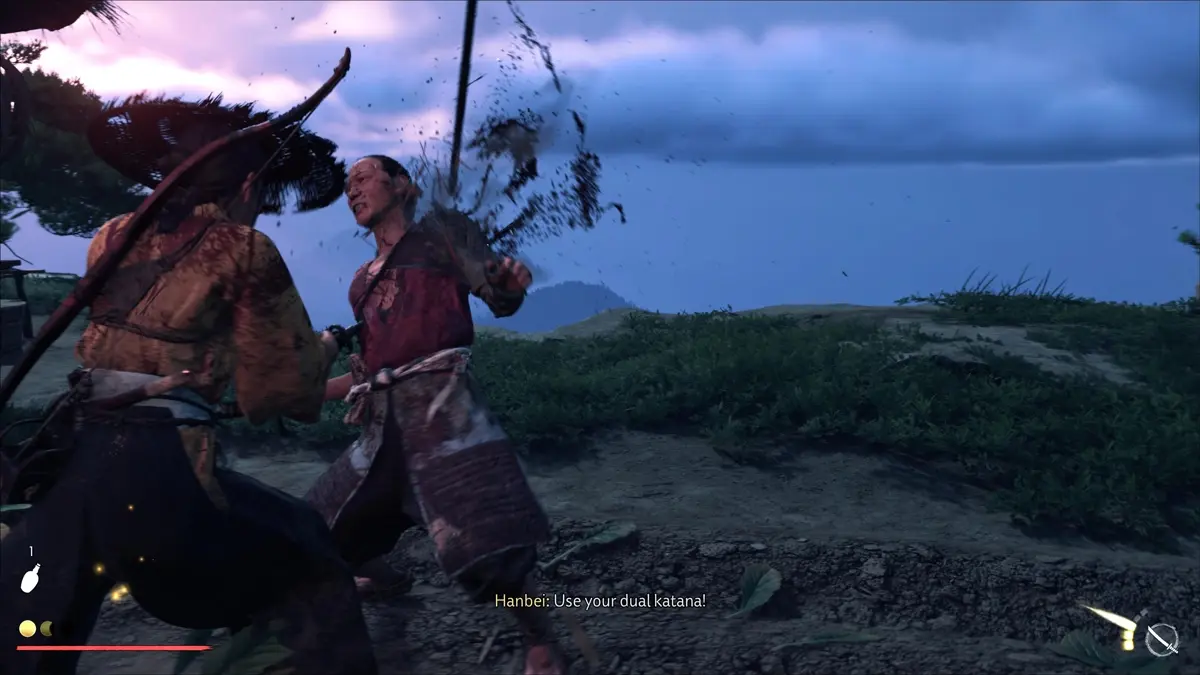
Ghost of Yōtei also swaps out separate stances for all-new weapons. Each of Atsu’s weapon is meant to be used against specific enemy types, such as the kusarigama, which does well against shielded enemies but poorly against big brutes. The design philosophy behind the stances is retained; players have to constantly swap between each weapon to deal with different enemy types in combat. It's just a little more satisfying to watch Atsu go ham on a big brute with her massive odachi, rather than use the katana's Moon stance.
In action, it feels much like Doom Eternal, where players have to make full use of Atsu’s weapons and abilities if they want to wipe out of a mob of outlaws. It’s impossible to go at it with your katana alone, but it’s also worth noting that you could wind up doing so if you don’t pursue certain sidequests. Atsu gains her weapons by consulting senseis scattered across Ezo, but many of them are optional sidequests that the game doesn’t force you to pursue. To get a full kit, you'll have to make a few detours.
Additionally, she can gain new weapon abilities by furthering each sensei’s questline. That’s just one of the many ways this game encourages players to break free from the main storyline and explore the world of Ezo. Even common stealth game tropes, like the ability to track enemies behind walls, took so long for me to gain that I’d thought they had been removed entirely.
The beautiful world of Ezo
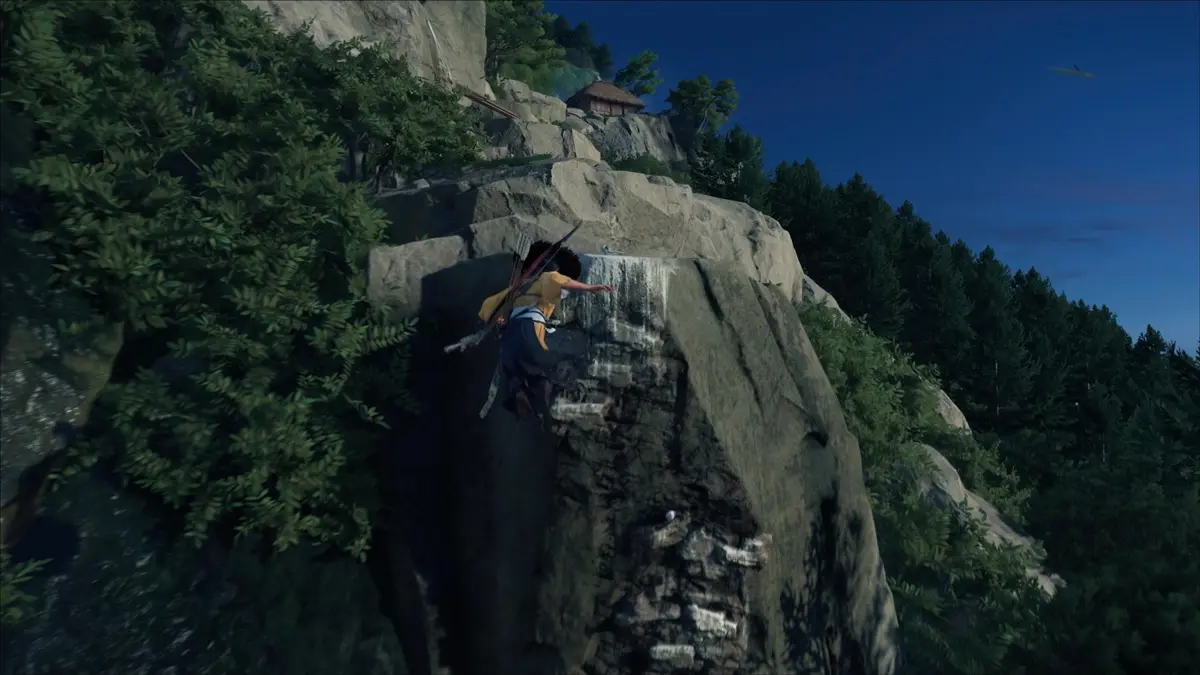
Ghost of Yōtei shares its predecessor’s emphasis on cinematic immersion, refusing to bog players down in floating UI elements onscreen unless absolutely necessary. When Atsu is on horseback, black borders encroach the screen, turning her travels into a widescreen experience. If players are looking for their next objective, they need only turn to the in-game map or call upon the Guiding Wind to highlight their path forward.
In a lesser game, players might feel disoriented with the lack of clear guidance, but this one finds other ways to keep players engaged during exploration. Ezo’s wide open plains and diverse biomes house striking points of interest that simply beg investigation, like red trees, burning buildings, or wolf dens, always within view at a distance. Even without the golden birds that bring Atsu to collectibles and hot spring baths, there’s plenty of secrets left for players to uncover themselves.
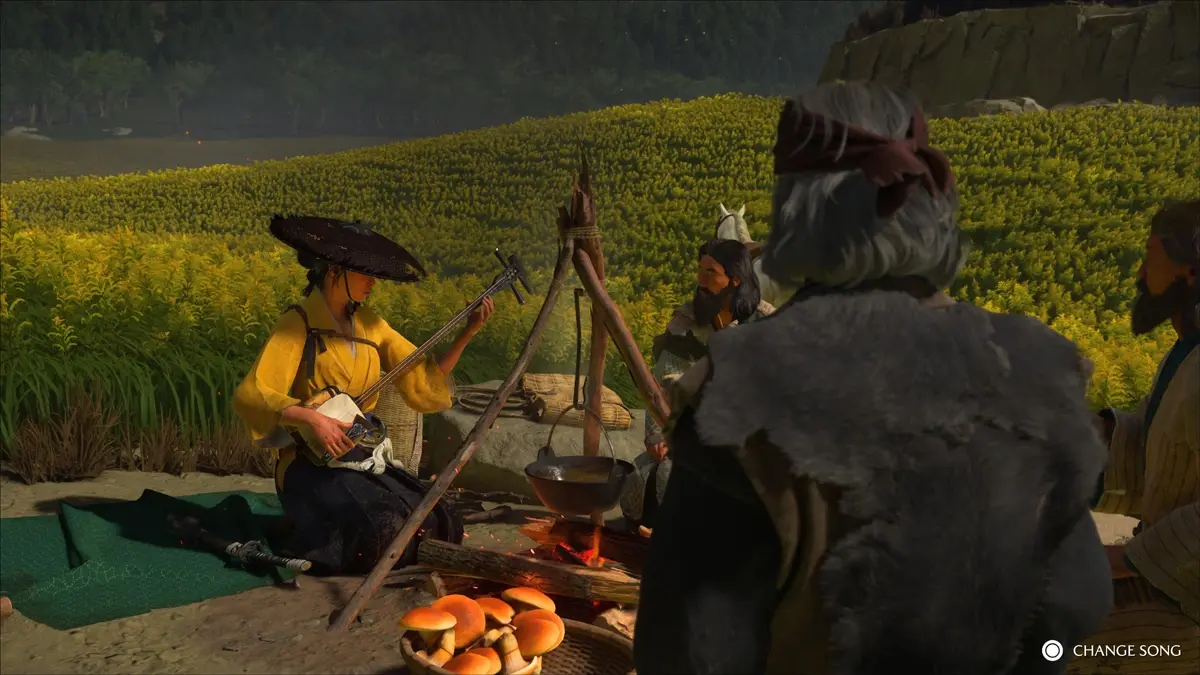
Thankfully, Sucker Punch has learned from Ghost of Tsushima’s often-criticised poor side quest variety. Ghost of Yōtei’s open world activities are much more diverse, their boundaries stretching well beyond the rinse-and-repeat hot tubs, animal dens, and enemy bases. Yes, those repetitive activities are still here–but they are now lost in the density of more story-heavy questlines scattered about Ezo, in which Atsu uncovers forgotten family history, gets involved in messy love triangles, and investigates ghost stories, all to score some money and cosmetics.
Ghost of Tsushima’s side quests felt like well-worn paths players had to travel in order to score sweet new gear for Jin. Ghost of Yōtei’s quests are interesting enough on their own, however, often presenting odd situations or tempting mysteries for Atsu to get herself involved in. Players unravel these tales to satiate their own curiosity, in addition to also scoring sweet new gear. It helps that her outfits are lavish as well, with multiple dye colours, ability perks, and fashion styles to keep players busy expanding her wardrobe.
Is Ghost of Yōtei another technical showpiece for the PlayStation 5?

Much like its predecessor, Ghost of Yōtei’s open world is a breathtaking technical showpiece for PlayStation consoles. Ezo’s valleys, mountains, forests, and rivers are brought to life with absurdly pretty visuals. The land is blooming with flowers and ginkgo trees of spectacular–and heavily saturated–colour. Even for players like myself who border on open world fatigue at times, it’s hard to deny the spectacle this game has to offer.
It helps that the story’s structure gives players plenty of space to explore. Two members of the Yōtei Six are available for Atsu to chase down at a time, and she is free to pursue whomever of the two she chooses. When two are cut down and the story advances, a new region becomes available, allowing players to explore the world in bite-sized pieces. The story has more to offer than cinematics, of course. As things heat up and Atsu’s legend grows, her battles with the Yōtei Six escalate wildly in both anticipation and scale.
It’s not a perfect system. With the lack of linearity that this campaign structure demands, the first act feels almost spiritlessly paced, bogged down in uninspired revenge tropes and repetitive Ronin encounters that give Atsu clues for her hunt. Because Atsu’s skill tree is also tied to exploration in the form of taking down enemy bases and finding shrines, instead of a levelling system, players are also forced into ticking all of these encampments off a box, lest they lose out on crucial combat abilities.
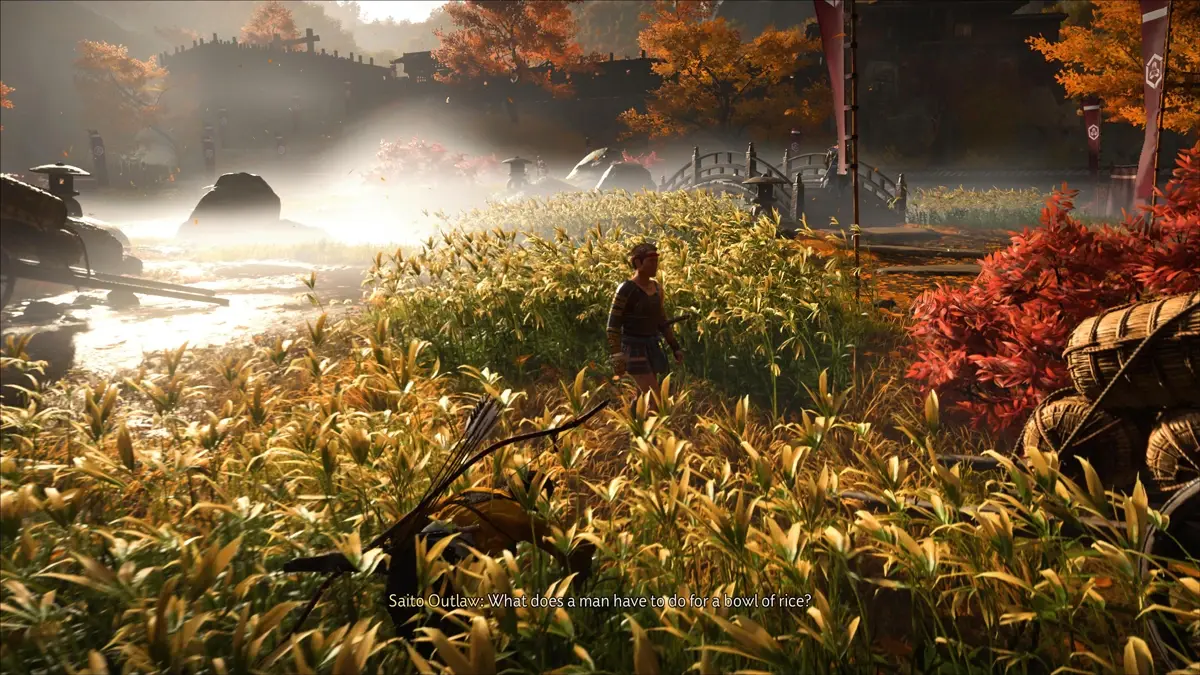
Ghost of Yōtei still suffers from much of Tsushima’s unfortunate jank. Enemy AI is borderline laughable, and this is especially apparent in stealth encounters. Enemies lose interest in Atsu much too quickly after being spotted, or can’t seem to zero in on her if she’s gained the high ground. Friendly AI isn’t much better, though I will say that the wolf–a bloodthirsty creature who stalks Atsu around in Yōtei imperceptibly–is pretty badass, sending enemies cowering in fear upon its arrival in combat.
The game also has a few visual bugs relating to the camera that cropped up for me, typically when I initiated dialogue with an NPC while standing too close to them, and the camera decided to give me a cinematic view of a nearby tree instead of the conversation at hand. The camera is difficult to wrestle with during combat in general, as it zooms in and out depending on what Atsu is doing and who she’s focused on. I also ran into a pretty serious crash early in my playthrough that froze up my console, forcing me to reboot the machine.
It’s worth noting that the game runs nigh-flawlessly besides this issue, featuring multiple performance modes that allow for gameplay at either 60fps or a high resolution, or ray tracing with dynamic resolution. It also does something I’ve rarely seen other games do, which is immediately load the player’s save file upon start-up and put them in the game–no main menu needed. In general, fast travelling and loading saves are lightning fast, almost confoundingly so for an open world this dense in detail.
Verdict
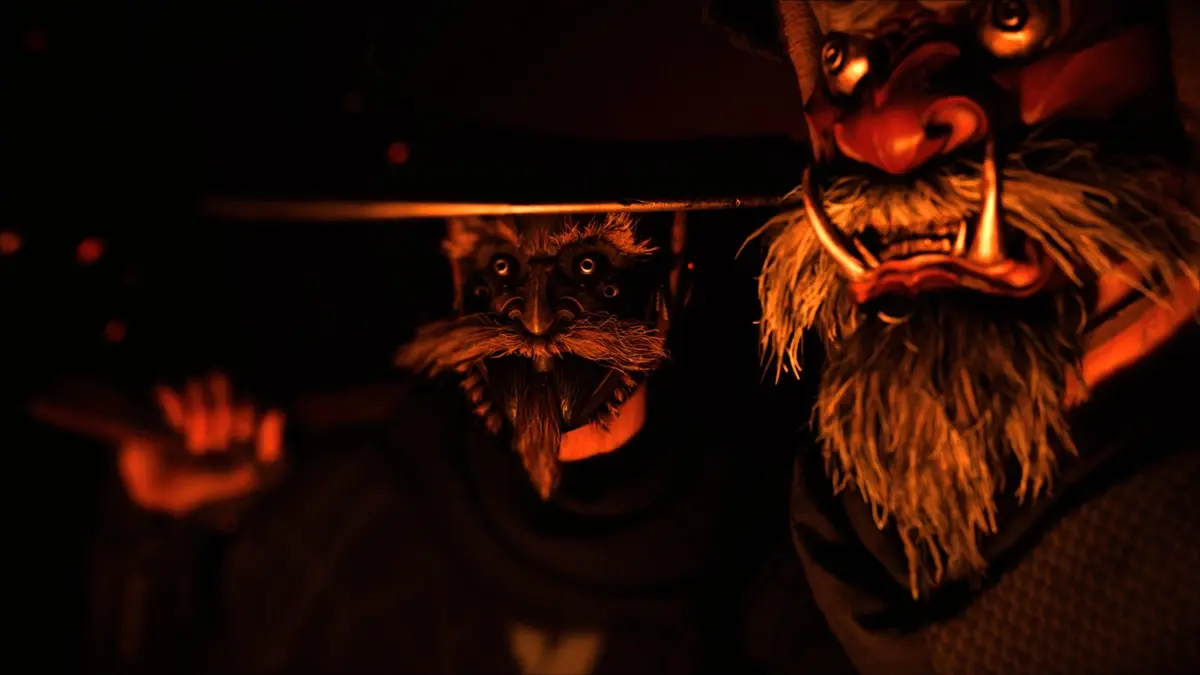
Ghost of Yōtei sees Sucker Punch Productions further refine its open world vision, combining a clever campaign structure with a deeply immersive playground to keep players wandering–but never far away–from the beaten path. Ezo is a gorgeous place to reside in for the duration of Atsu’s tale, which is tender and moving despite the bloody events which set it off.
Where a slow start threatens to curtail the game’s momentum, its diverse activities, memorable cast of characters, and tight combat will keep players hooked until Atsu sees her mission through.
Ghost of Yōtei launches on PlayStation 5 for US$69.99. We received a copy of the game for this review.