

Text by: Nydra
Ever since Heart of the Swarm and its new units were first announced, there has been little ambiguity as to what the expansion’s design idea was: it was about diversifying playstyles by providing options more than balancing out the races and the state of the game.
To fit into that idea, Protoss got two new fliers to make the expensive Stargate tech useful outside light harassment and scouting. Terrans saw improvements to their Factories, now able to churn out units which were supposed to introduce dynamics into TvT and provide a viable mech composition for TvP. And Zerg…
Ever since Heart of the Swarm and its new units were first announced, there has been little ambiguity as to what the expansion’s design idea was: it was about diversifying playstyles by providing options more than balancing out the races and the state of the game.
To fit into that idea, Protoss got two new fliers to make the expensive Stargate tech useful outside light harassment and scouting. Terrans saw improvements to their Factories, now able to churn out units which were supposed to introduce dynamics into TvT and provide a viable mech composition for TvP. And Zerg…
THE ZERG IN WINGS OF LIBERTY
If Zergs in Wings of Liberty lack something it is that one mid-game unit that can decisively break enemies after they’ve made the costly mistake of losing a big battle. Zergs generally choose to throw in an extra expansion and delay the end of the game further instead of going for the throat, as a Tank-centric defense or a Colossus/Sentry ball will usually be more cost efficient against Roaches, often to the point of coming ahead even when down in supply. Knowing that their mid-tier push will likely be crushed, Zergs prefer to lay back, tech to Hive and close the game with Brood Lords. While this is by no means a bad thing, it’s a stylistical flaw that strips Zerg of certain dynamics.
Hive tech also has the “problem” of not providing enough viable options. Brood Lords are the staple in late-game as they can, unlike Ultralisks, effortlessly break positions and push in for a finish. With Neural Parasite and Fungal Growth the Brood Lords/Infestor army is in many ways superior to an Ultralisk one, which requires flawless use of Fungals to be efficient against armies. Additionally, the absence of any caster besides the Infestor usually leads Zergs into the pitfall of being that boring-to-watch race that does the same damn thing every single late-game.
To top it all, Zergs are in the possession of the heaviest deadweight unit since BroodWar’s Scout and see play time as rarely as do Carriers, mass Void Rays or Reapers. Once one of the core units of the swarms of old, the StarCraft 2 Hydralisk lies sulking in the dark, god forsaken cellars of the Zerg and is constantly overlooked as at every stage of the game there’s another unit that does its job better. As nowadays Nydus Worms are rare at best and as the constant increase of map sizes never allowed the “creep highway” to cross the frontier of the new decade, the Hydras have devolved into the least used weapon in the Zerg arsenal, not built even in the face of heavy air harassment. The last time they were used was in this quote:
- "I was so ahead [against Naniwa] that I thought I could make any unit and still win so I chose hydras. However, it seems hydras are still the symbol of defeat. From now on, unless it’s a special situation, I will never use hydras."
- DongRaeGu
Again, Heart of the Swarm is mostly about introducing a diverse gameplay and that is why Zergs woke up one morning and discovered they were richer in units and in upgrades.
THE NEW UNITS
Swarm Host
Cost: 200 minerals, 100 gas, 3 food, 40 seconds
Abilities:

Cost: 200 minerals, 200 gas, 120 seconds
Increases the lifespan of Locusts by 10 seconds.
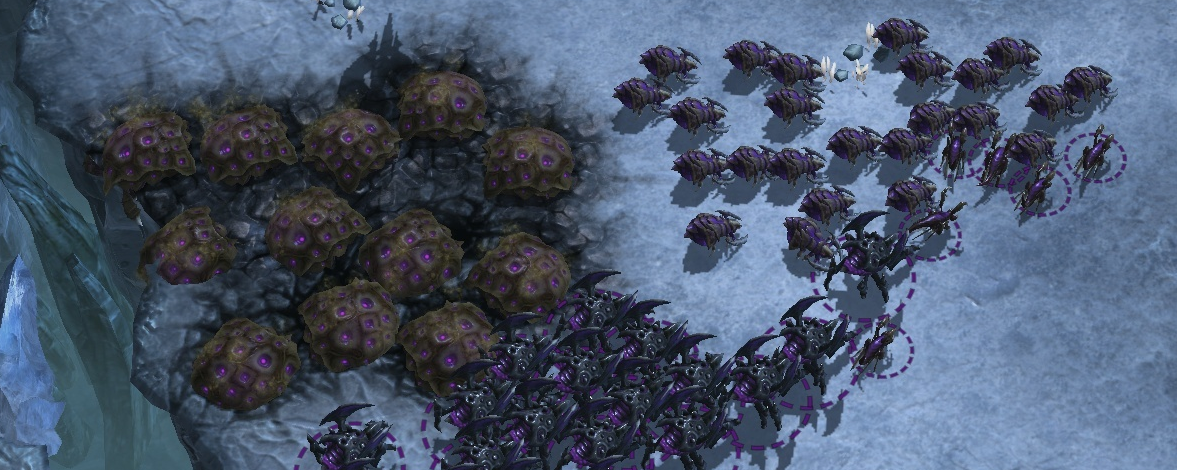
The Swarm Host is here to fill the void left by the lack of a siege unit in the Zerg arsenal and is an addition directly tied to what we mentioned a few paragraphs below – the opportunity to directly put deadly pressure on an opponent, regardless of how fortified he might be.
The mechanics of the Swarm Host completely eliminate the question of cost-inefficiency. Much like the Brood Lord, the Host attacks with free units that spawn every few seconds, deal absurd amount of damage (less absurd now that the patch hit the servers) and are the best thing that Zergs have for breaking down walls.
Before the first beta patch, the Swarm Host meant almost a guaranteed win against a Protoss who plays passively or makes a fatal slip during an engagement. An army of six or seven Hosts (a number easily reachable as the units is cheap on gas for the services it provides) complemented with Roaches is nearly too powerful, even for a Colossus ball. Right now, the timings are deadly and a three-base +2 attack Swarm Host push can catch the Protoss at an awkward moment as neither Stalkers nor Immortals nor chargeless Zealots are particularly helpful against the Locusts, which spawn two at a time, get a +2 damage for every attack upgrade and have a starting damage of 16 (now 14).
When it comes to ZvT, the effectiveness of the Swarm Host is debatable. Prior to its damage reduction, a Locust would kill a stimmed Marine with +1 armor and Combat Shields without losing as many as half of its hit points. En masse and in a combination with banelings, the Swarm Host is the perfect unit to horrify a defensive terran. His weaknesses in this match-up lie in his vulnerability to mech and the fact that a bio terran will rarely remain so passive as to give the Swarm Host the chance to gnaw at its targets. The Host’s low mobility off creep and diminished power in mid-map engagements provide more than enough opportunities for the Terran to deliver a killing blow.
Viper
Cost: 100 minerals, 200 gas, 3 food, 40 seconds

Abilities:

No cost
Targets friendly structure (excluding Creep Tumors) and consumes 200 life over 20 seconds converting the damage dealt into 50 energy.

Cost: 75 energy
Pulls a target unit to the location of the Viper.

Cost: 100 energy
Creates a cloud for 10 seconds that reduces attack range of all units under it to melee range.
The beautiful unit that it is, the Viper has been created with one thought in mind – versatility – and unlike the Infestor which supports every army in every match-up, Zergs’ new caster varies from less than useful to borderline overpowered depending on the situation.
Since it was first revealed, the Viper was affectionately called “the flying Defiler” and not without merit. Much like the Brood War caster in question, the Viper has the power to destroy the cohesiveness of late-game armies and/or deny whatever makes them powerful. Being the only combat unit that requires no additional tech structure (besides Hive, of course) and with Consume in his character profile, the Viper is wonderful when emergency tech switches are required and can also set late game tempos as it has the power to force an opponent out of certain army compositions.
Following the overall theme of the Viper, the Blinding Cloud ability can easily be a liability as well a game breaker. Its small range of 1.5 does less than nothing to highly mobile armies like terran bio or blink stalkers or every ZvZ composition but is the king of the show when it comes to breaking through tank lines or fighting other compositions that find it hard to maneuver around. A line of Blinding Clouds can force a reposition away from choke points or ramps, further easing Zerg’s advancement through problematic areas.
The fun continues with Abduct, the bane of Colossi, Immortals, Tanks and every other unit that needs to be behind the entire Chinese army to do its job properly. Abduct’s applications vary from dragging anything into your line of fire, repositioning it to awkward places (including highgrounds, lowgrounds or simply away-from-everything-else-grounds), setting up an easier Neural Parasite follow-up or all of the above.
When the threats it is supposed to counter are gone, however, the Viper stops being applicable. Dissimilar to the Infestor, it does nothing to large, low cost per unit armies and simply becomes a waste of supply.
For all I know, the Viper is the better caster design-wise. It might very well be the single most interesting unit the Zerg have.
Beggar's new clothes
Abilities:

Cost: 200 minerals, 200 gas, 130 seconds
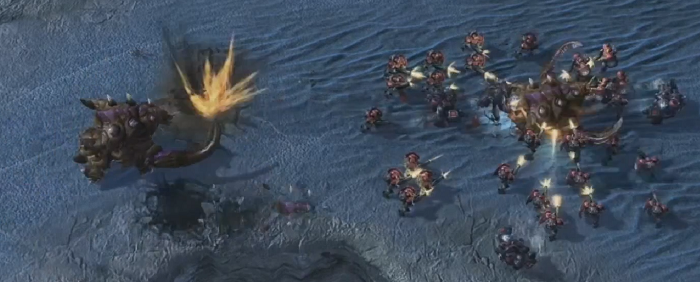
Burrow and charge towards a unit. Upon unburrowing all units in the vicinity are knocked back and suffer normal attack damage.

Cost: 150 minerals, 150 gas, 100 seconds
Hydralisks move 25% faster off creep.
Apart from getting new stuff, the Zerg is the only race that gets new upgrades for its old units. Targeted are the Ultralisk and the Hydralisk which, according to the educated public opinion, just suck.
The Hydralisk speed aims to resurrect the unit as a late-game ground raider, now able to sprint to expansions, snipe them down and retreat. What bothered me personally is that the Hydras are still illegally expensive, fragile in direct confrontation and when caught out of position they become a devastating loss for the zerg. Most of the late games, I caught myself still sticking to ling run-byes for harassment purposes as they were both free and more mobile. With the Muscular Augments available only after Hive, I could not for all my attempts find timings where I would use Hydras and not other Lair/Hive tech available in Heart of the Swarm.
The Burrow Charge for the Ultralisk is arguably the better addition. Despite taking half an eternity to research, the skill reduces to some extent the absolute need for Fungal Growths in Ultralisk compositions as said Ultras can now safely close the distance to enemy units before being shot down.
Here’s a crossing of fingers that ZvX non-mirrors get more dynamic next year.

![[Op-Ed] Women in competitive gaming – why are there so few?](https://static.gosugamers.net/8f/c9/2c/df69cf93db41c27a46978529e01614f38e0bfb80888132ac95fd3f89fb.jpg?w=1600)