

|
|
 Rdu's mid-range Warrior
 Azeri's Bloodlust Shaman
 StrifeCro's Ancient Mage Shaman
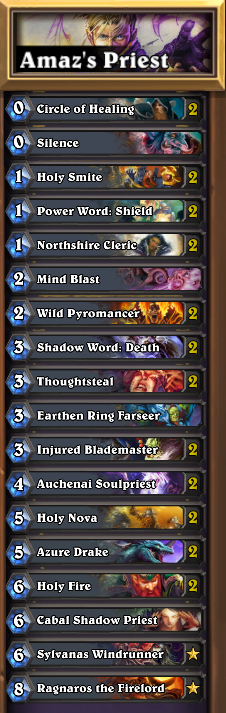
 Amaz's Druid and Priest
IEM Shenzhen is over and a champion has been crowned – Jason “Amaz” Chan. Between July 16th and 18th, thousands of fans tuned in to watch the first full-blooded Hearthstone tournament on the IEM stage. They witnessed upsets, rivalries and young stars rising but with Hearthstone there’s always one more thing that’s interesting about a tournament – what decks the best players played.
Most of the builds that were brought to China were no real shocker. Miracle and Handlock versions were used widely across the tournament with little to no changes to the cookie cutter builds. We also had some token Druids, control Warriors, Zoo and a pinch of Mages all of which were more or less standard.
However, there are a few decks that stood out. Below, we feature five decks from some of the best players in the tournament – Amaz, Rdu and Azeri. They vary from being entirely new interpretations of the class to being mixes of styles or just incredibly successful.
For more IEM Shenzhen coverage including VODs, news and results, visit our dedicated hub.
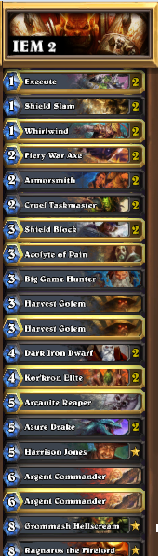
Starting with the reigning DreamHack champion, we take a look at MYM’s Radu “Rdu” Dima and his mid-range Warrior. This build goes away from the heavy control style that ruled the ladder before the rise of the Miracle Rogue; it adds a touch of aggression aimed to apply pressure to slower decks but also keeps some of Warrior’s best defensive cards and removals. The deck has a nice flow and offers a lot more variety than the pure control or pure aggro builds.
The low end of the mana curve is in the control spectrum. Between 1 and 3 mana there are cards like Execute, Shield Slam, Whirlwind, Armorsmith, Shield Block, Acolyte of Pain, Fiery War Axe and Big Game Hunter, all of which are present in the standard control builds. These cards add just the right amount of removal and card draw that the deck needs without fully committing to the control idea. Neither Slam nor Cleave have been included, which opens necessary slots for some valuable mid-range cards.
Having all the removal at 1 mana is especially important for this build. The mid-range Warrior is a minion-based Warrior rather than a spell-based one and you need to be able to play minions alongside removals to both keep your opponent’s board in check and build up your own side of the battlefield. This can explain the absence of Slam – in control builds, it’s a great card as it is often cycled away while dealing damage but it’s also meant to be followed by another removal, usually an Execute or Shield Slam. It’s a spell for spell-heavy decks and this is not such a deck – you need to keep the tempo with minions and burning 2 mana for a Slam can kill this.
In the middle of the curve is where all magic happens. Between 3 and 6 mana there are a total of 11 cost efficient minions who are there to win you the board control and chip away at the opponent. Harvest Golem, Dark Iron Dwarf, Kor’Kron Elite and Argent Commander are all there to trade efficiently with the enemy board, making for one very Zoo-esque playstyle in the mid-game. Additionally, we see two Azure Drakes which are always a good deal with their spell power and card draw and a Harrison Jones to counter weapon-wielders like Rogue and Shaman. A single Arcanite Reaper adds one more source of damage which can be used to either finish the enemy character or clear that annoying taunter or pesky Yeti.
The end of the curve is also not as saturated as that of control Warriors. Where the latter would invest most of their dust to craft a formidable late game, Rdu’s expensive part of the deck has only Grommash (great finisher with Whirlwind or Cruel Taskmaster) and Amaznaros Ragnaros. The absence of cards like Alexstrasza, Baron Geddon, Ysera or Gorehowl conveys a clear message – most of your damage must be dished out in the mid-game and Grommash and Ragnaros are there only to blast down the last points of damage. They are not cards that sit on the board for more than a turn, usually, so you need to have the stage ready for their entrance.
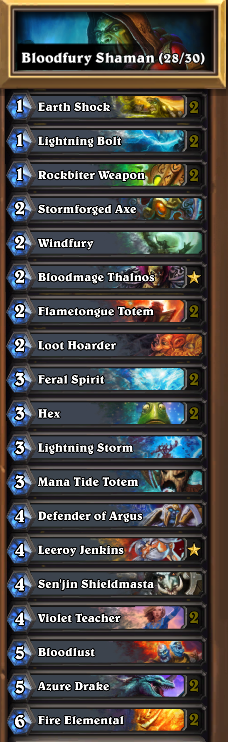 Players have been experimenting with Shaman a lot and one of the latest favorite cards is Violet Teacher.
Violet Teacher, in particular, has been getting a lot of attention due to its ability to populate the board and has made appearances in several other decks. Aggro Mages love it for its synergy with their low-cost spells and it’s also the core of the Druid tokens as the class has various ways to either cast it early (Innervate, Wild Growth) or buff the 1/1 tokens (Power of the Wild, Savage Roar).
In Shaman, the Violet Teacher takes the best of both worlds. Thrall is known for his cheap spells and Lightning Bolt, Earthshock, Rockbiter Weapon all work well for Violet Teacher. Additionally, we have Bloodlust – usually a card you will never see in competitive Shaman decks – which is here to turn the tokens into vicious 4/1 finishers.
As you can see, the deck is all about dishing as much damage as possible. Double Flametongue Totem and double Feral Spirit make for a strong mid-game opening. In the middle of the curve, cards like Defender of Argus and Sen’jin Shieldmasta come in to protect Violet Teacher so she can spawn tokens in piece. One the board is populated, Bloodlust is triggered and enemy’s hit points go away.
To add even more fuel to the burst, Azeri has decided that it’s a good idea to add Windfury and Leeroy Jenkins so nobody is safe from lethal, even at high life total. Leeroy/Windfury comes to replace Al’Akir used in traditional Shaman decks and nicely finishes up that idea of dishing out as much damage as possible in a single turn. With two Rockbiters, Leeroy can come in swinging for as much as 24 damage, leaving two more unused mana crystals at T10 for any necessary follow up.
Unfortunately, we couldn’t parse all 30 cards of Azeri’s Shaman just by scouting the VODs and there are 2 cards which are still unknown. Being a token build, one could assume these are two Argent Squires but it’s also possible that Azeri has neglected the early drops altogether in which case Doomhammer (fits well in the whole Windfury theme), second Lightning Storm (against aggro decks), second Defender of Argus, Unbound Elementals or Harvest Golems are all good options.
If you want another interpretation of the whole Violet Teacher aggro theme, make sure to also check out Faramir's GosuCup-winning aggro Shaman from two weeks ago here.
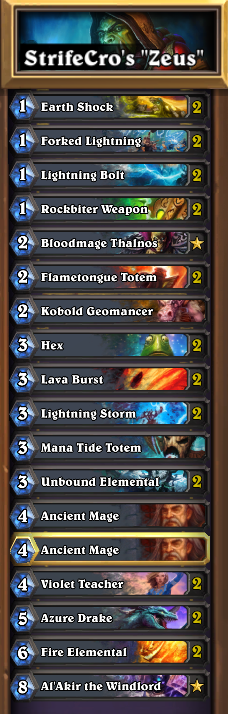 StrifeCro has always been a player who likes to do weird stuff in a certain meta and think differently about what kinds of decks would work in a certain environment. At IEM Shenzhen, he shocked people once again by bringing an Ancient Mage Shaman deck, because why the hell no.
In all honesty, the idea for a spellpower Shaman doesn’t really belong to StrifeCro. In the past, we’ve featured builds like DKMR’s Zeus which then used Malygos and Gadgetzan Auctioneer, but StrifeCro is the first one to bring it to such a big tournament as IEM.
There are a few notable oddities in Strife’s build. First, we see a double Forked Lightning to heavily counter aggro builds (Zoo, Tokens, Backspace Rogue as well as other Shamans). Forked Lightning is usually used one-of or omitted entirely due to its big Overload cost that clutters the curve but StrifeCro seems to have no issue running two of these as fast decks are indeed Zeus’ biggest weakness.
Further down the line we see a single Kobold Geomancer, acting like a second Bloodmage Thalnos. You won’t get the card draw from Thalnos but it’s still one extra spellpower and that’s what this deck is all about. There’s also double Lava Burst on the 3-mana-slot, which is another card usually ran one-of.
Taking a look at the upper half of the curve and comparing it with DKMR’s Zeus, we see a few notable differences. Gadgetzan and Malygos are gone and instead we have double Violet Teacher. There’s also Al’Akir for some late-game punches.
Of course, we must say two words about the double Ancient Mage which is the build-defining card for the Zeus. Ancient Mage synergizes well with Shaman’s totems and the most important part about it is that his effect does not go away when he’s killed. Spellpowering adjacent minions on Battlecry is great – it draws the attention away from your other minions as the opponent tries to keep your spell buffing power under control. Being as cheap as 4 mana also gives you enough free crystals to immediately follow it up with a barrage of spells for lots of damage.
Another notable change compared standard Shaman builds is the absence of Feral Spirit. Yes, that’s right – there is no early game board populators and all the deck does in the small turns is clear the board with spells and build towards a strong mid-game and a bursting finish.
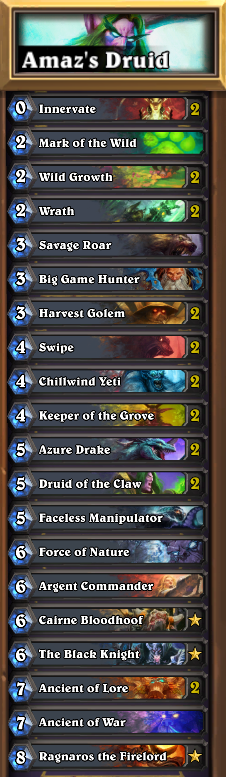 We can’t talk about IEM decks and not mention what the champion was playing. On the right, we see Amaz’s championship-winning deck in the form of a new-school ramp.
The Ramp Druid became very popular (again) right after Gaara’s victory at DreamHack Bucharest. Gaara’s variation used lots of taunts like Sunwalkers and double Ancient of War as well as card like Nourish and Healing Touch which are rarely seen outside the very slow Druid builds.
Amaz’s ramp from IEM Shenzhen, however, mixes the ramp basics with some elements from the new school Druids. The curve starts with double Wild Growth which is a match-breaking card in mirrors especially (and overall great for speeding up your curve) and continues with the standard mid-range arsenal: Harvest Golems, Yetis, Keepers, Druids of the Claw and Azure Drakes.
The build is also quite heavy from 6 mana and up. Cairne, Black Knight and Argent Commander all scream “value” and so do the obligatory 2x Ancient of Lore. On top of them, there’s a single Ancient of War (running two is a bit unnecessary as they are easy prey to Black Knight) followed by Ragnaros. And if you’re Amaz, you want Ragnaros!
Other than that, there isn’t much more to say about this deck – it’s a straight forward one and you’ll be making the same choices as with every other Druid deck. Speed up your curve and establish strong mid-game position and continue playing cost-efficient minions to win the board battles. Try to bait out Black Knights, Saps and silence effects before playing Ancient of War if possible – a 5/10 taunter is game-winning if the opponent has no way of disposing of it in a clear way.
Oh, and there's just a single Force of Nature/Savage Roar combo, make sure to be precise with them.
Finally, we know everyone loves to see Amaz's Priest so here it is for you:
Do you like what we do? Follow us on Twitter.
Photos: ESL