As after every bigger televised Hearthstone event, we at the GosuGamers offices sit down to bring you a detailed breakdown of said event’s metagame as we scout for trends, shifts and quirks. Today, we take a look at the StarLadder Kick-Off Season, a 16-man tournament with close to $10,000 prize pool, which just recently ended with James “Firebat” Kostesich taking the title over Aleksandr “Kolento” Malsh.
The StarLadder tournament featured a standard 3-deck Conquest line-up for each player but allowed for change of decks and classes between the group stages and the playoffs. This provided a bigger number of classes and archetypes, enriching our data. Below, we will examine the pick and win rates of the classes, look at class distribution in the line-ups and put all played archetypes into graphics.
Let’s get started.
Popularity and win rates
Shortly after the full launch of Blackrock Mountain, Warlock/Warrior/Hunter established itself as the holy trinity of the new metagame. These classes enjoyed stable and solid builds, making them a lucrative pick for any conquest line-up.
The modern Warlocks still channel their trademark diversity, ranging from different builds of Zoo to slower Handlock and [card]Malygos[/card] builds. The class can suit virtually any playstyle and picking one before the other doesn’t put you in a real disadvantage.
Hunters are also running dominant, despite dev’s team’s multiple attempts to tame the class. If around the time of HouseCup #2 players gravitated mostly towards Face Hunter with a gentle transition into the new Hybrids, nowadays Midrange is the prevalent type, though the other two remain a potent threat that should not be counted out.
And, of course, there’s Warrior carried by the mighty shoulders of [card]Grim Patron[/card]. Largely considered as the best deck in the current metagame, it is no surprise to see it brought incredibly often, despite its volatile nature (not drawing combo pieces can mean losing on the spot) and high skill cap.
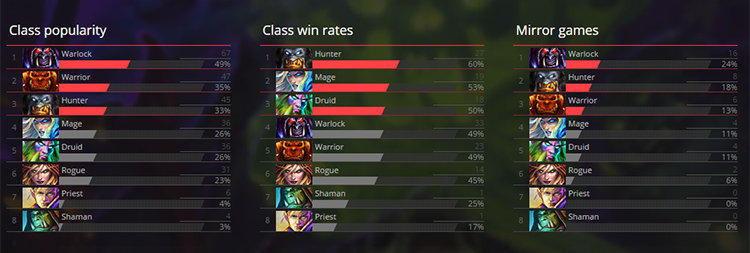
Interestingly enough, though, two of those three classes did not do too well in StarLadder, with Hunter being the only class with a positive win-rate and leading the scoreboards with 60%. At the same time, both Warlock and Warrior are stuck at 49%, just below the “bridesmaids” Mage and Druid. Why is that?
The simplest way to explain it is visualize the circular metagame of Hearthstone, where a Deck A counters Deck B but is countered by Deck C. At the same time, while Deck C counters Deck A, it gets countered by Deck B. Confused? Let me elaborate.
Patron Warrior will usually have a tough match against Handlocks and Malylocks. Those two, on the other hand, will have a hard time against Hunter builds. And Hunter builds will usually be beaten by the high armor gains of Warrior. When one of these decks happen to be more popular, the deck it counters suffers.
In StarLadder, Warlock was the most played class, and thus the Patron Warriors win-rates dropped. At the same time, though, the prevalence of Hunter prevented Warlocks’ win-rates from skyrocketing. Furthermore, Warlocks played a lot of mirror matches, not really getting the chance to channel its strength into a positive win-rate.
While Warlock and Warrior were dealing with their problems, other classes were able to outrace them. Jaina and her new [card]Flamewaker[/card] builds pushed the class to 53% win-rate in the tournament, being the only class with favorable record against Hunter.
Line-ups and archetypes
As mentioned, StarLadder allowed for change of classes and decks between stages, which meant that a sort of class sifting could potentially be observed between those players who reached top 8 and their colleagues who didn’t make the cut.
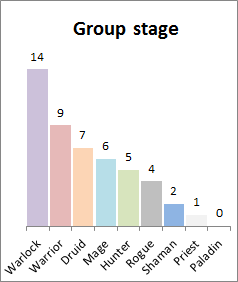
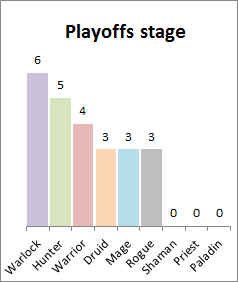
At first sight, we can see that the few Shamans and Priests which were brought to the group stage never appeared in the playoffs. That’s mostly because its pilots Forsen (Shaman), Kalaxz (Shaman) and StanCifka (Priest) were eliminated. What’s worth pointing out is that Hunter was not at all popular during the group stage, and was the fifth most chosen class, right behind Druid and Mage. Hunter only made it to the top three as the number of Druids and Mages dwindled.
The elimination of Shaman and Priest, alongside the complete disregard of Paladin, meant that only six classes in total were brought to the playoffs. With the numbers being relatively close, this is a clear indication of a limited, but balanced meta.
Despite Warlock, Hunter and Warrior being on the top of the charts, they were paired together in just one line-up, that of Jon “Orange” Westberg. Every other finalist chose one or two of those classes and supported it with Druid, Mage and/or Rogue. For Firebat, the line-up of choice consisted of Freeze Mage, Zoo and Midrange Hunter, while runner-up Kolento brought Face Hunter, Oil and Patron Warrior.
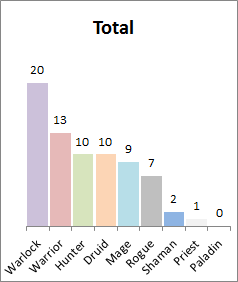
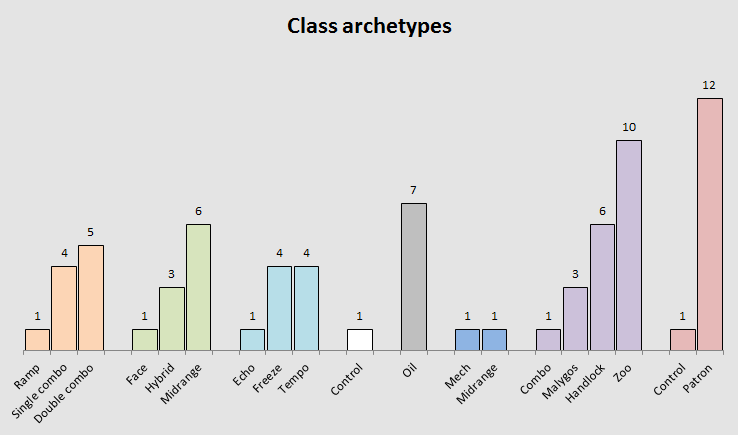
Speaking of archetypes, the trends we observed during the last few bigger tournaments haven’t really changed. Druid, Warrior, Warlock and Hunter have one leading build that pushes down the others somewhat (in case of Warrior – pretty dominantly). Mage is equally split between Freeze and whatever else is out there – in that case [card]Flamewaker[/card] tempo – and Rogue has no variety in its builds whatsoever.
In conclusion to that last part – we need a fresh injection of cards, stat. Observing little to no change over a large period of time is a signal for a stale metagame, and that could make for deteriorating level of enjoyment.
July 22nd can’t come soon enough.
More on Follow @GosuGamersHS