 Lifecoach |
 Naiman |  Lothar |  StrifeCro |  Nicolas |  Freshca |  Reynad |  Kranich Kranich |  Firebat |
Episode 1: Gnimsh, Reynad, Rdu, Darkwonyx, Realz, Massan, Xixo, Forsen
Episode 2: Kolento, Firebat, Hyped, Reynad, Reckful, Forsen, Gaara, ThijsNL, Kitkatz
Note: Have in mind that all nine decks have been screenshot at different points of time so by the time you're reading this article they might've undergone changes. After all, climbing the ladder is all about making constant, minor improvements but in the end this collection should be enough to give you the basics on how to build for a certain class.
Going back to the start of competitive Hearthstone and following game’s history up to this point, druid is probably the class which has seen the most transformations and iterations in terms of what archetype is most viable. Midrange, ramp, watcher, tokens, single combo, double combo, new school mid-range – the variations were abundant and adapting towards the metagame, making the druid one of the most consistent and solid classes, period.
Towards the end of the life of the current metagame, it looked like there’s no more innovation to be found with the class as the builds heralded by the likes of Kolento and Firebat became the standard. That was until DreamHack Winter happened and miracle druid (re)appeared.
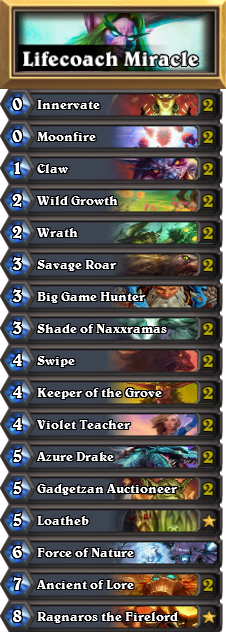
Although it was Lifecoach who popularized it in contemporary meta, the roots of this deck go way back, around the time of the first NESL King of the Hill series. Back then, the deck was played with [card]Malygos [/card] and relied on an [card]Alexstrasza[/card] into double spell-powered [card]Moonfire[/card]s to finish the opponent. Nowadays, it works a bit differently.
The new miracle druid is very much a mash of cards that are the center of other builds and somehow manage to work well together. At the heart of it all is [card]Gadgetzan Auctioneer[/card] in his last jolly days before the nerf. We have the [card]Violet Teacher[/card] coming in, all the nice druid removal, some [card]Wild Growth[/card]s, some [card]Claw[/card]s even – all the necessary tools to extract card draw or token efficiency. Once the table is ready, double [card]Savage Roar[/card] for the win.
Naiman is not technically a “pro” player since he didn’t achieve anything on the competitive scene. What he did do, though, was hit top two legend with his hunter.
Before you man your pitchforks and go after yours truly, shouting in anger and frustration how anyone can place high legend with hunter and that one particularly balanced card called [card]Undertaker[/card], let me come in defense of Naiman’s deck. True, it has [card]Undertaker[/card]s and [card]Webspinner[/card]s and [card]Haunted Creeper[/card]s, i.e. that smooth early game curve which forces an auto concede from the already slightly deranged ladder grinder, he does run a lot of weird stuff towards the higher end of his curve. It starts with [card]Cult Master[/card] for card draw, goes into a single [card]Savannah Highmane[/card] (yes, just one) and then suddenly – KAPOW! – [card]Ragnaros the Firelord[/card], [card]Sea Giant[/card] and even god damn [card]Deathwing[/card]. What is that? Nobody told me that was an actual thing in Hearthstone.
Looking at the build, it reminds me somewhat of Gaara’s Zoo/Giant warlock mix from almost half a year ago – a deck that saw very little competitive play but was genuinely fun to use on ladder as it confused the heck out of people – so I would wholeheartedly suggest you try it if you have [card]Deathwing[/card] for some reason and haven’t disenchanted him yet. It’s a fresh take on a class that has grown very stale in terms of builds so even the sheer enjoyment of trying something new should be enough to give this a go.
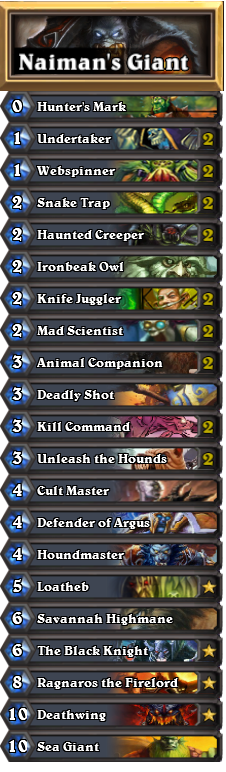
When he attended SeatStory Cup II, Lothar brought a mage deck designed by ROOT's Ostkaka, that was titled “Shouldn’t work but does”. What a perfect description.
Lothar ended up going 6-0 in the group stages with that deck against StrifeCro and Socke but that didn't explain how and why the deck really works. To add more to the mystery – this has been my personal favorite deck for the past month to play on ladder and it’s pulling its own weight against the otherwise disastrous hunter match-up.
This secrets mage does take a long time to learn, which many would consider a waste of time, given the fact you’re still one [card]Flare[/card] away from getting killed. Whoever commands it needs to know which secrets to get and at what time (e.g. [card]Duplicate[/card] before developing [card]Sludge Belcher[/card], [card]Counterspell[/card] before druid’s combo, and so forth), when to trade and when to go for the damage race. In its core, it’s a midrange deck but being a mage one it always has the burst potential and when played and calculated correctly, it can outrace even hunters.
Its biggest weakness, in fact, is the zoo. Not getting a [card]Frostbolt[/card] early on means you lose 90% of the time and even when you do get it, the percentage doesn’t increase dramatically. The best hope is to survive until a [card]Duplicate[/card]d [card]Sludge Belcher[/card] and weather the storm, but [card]Ironbeak Owl[/card] also kills you on the spot. In most other match-ups, though, the deck performs steadily. It shouldn’t work, but it does!
Paladin has been absolutely forgotten in recent times and nobody cares about good old Uther. During DreamHack Winter, it was one of the least represented classes and for good reason – the amount of zoo makes it very hard for paladins to survive, hunter is also a difficult match-up and on top of it all there’s all that weapon hate that’s there to counter hunter and warrior.
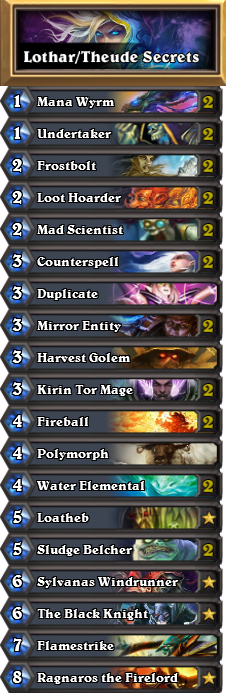
Nevertheless, we ought to have a paladin deck in the article so here’s what StrifeCro has come up with. His “crusher” paladin is a bit lighter on taunts (no [card]Sen'jin Shieldmasta[/card], no [card]Sunwalker[/card]s) but it compensates with a lot of reactive cards.
Where most decks run one of either [card]Harrison Jones[/card] or [card]Acidic Swamp Ooze[/card], StrifeCro goes for double Ooze. There are two silencers in [card]Ironbeak Owl[/card] and [card]Spellbreaker[/card]. There’s the ubiquitous [card]Big Game Hunter[/card] and [card]Stampeding Kodo[/card] and even a pair of [card]Zombie Chow[/card]s to battle [card]Undertaker[/card]s and shaman totems. Everything in the deck is about answering threats – kill everything, live till [card]Ysera[/card], outlast your opponent. The way real paladins fight.
Priests are a class that hasn’t changed much since the launch of Naxxramas and generally their builds fall in two categories – [card]Undertaker[/card] priests and pure control priests.
Puzzled with what new I can offer on these pages, I went hunting all the way to the east and scouted the players in the Chinese NEL. They are a strange folk, I thought, surely the local metagame would have bred an interesting type of priest.
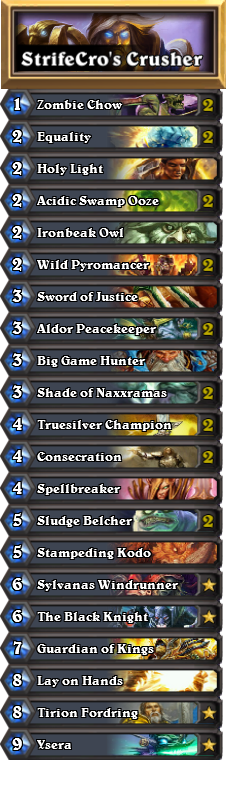
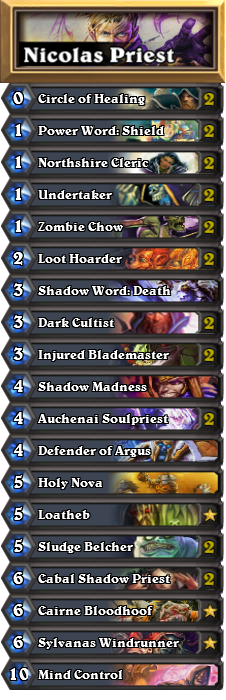
Unfortunately, it hasn’t. Here, we see what one of China’s finest in Nicolas uses and it’s not really that different from western [card]Undertaker[/card] priests. It’s the good old minion-based deck that has barely any removal and asserts board control via minion trades and healing. Nothing more to say about it.
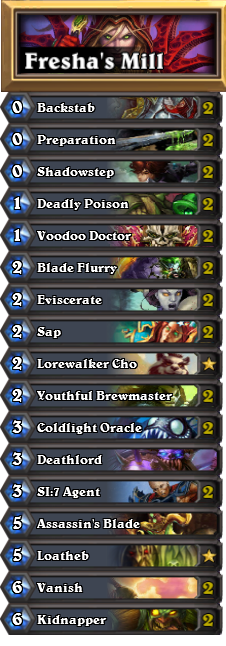
I asked the question “What is that?” once already in this article but I’m about to use it again as I bring you Freshca’s “Finding Nemo” mill rogue.
Mill decks have been attempted in the past as players experimented with [card]Lorewalker Cho[/card] and [card]King Mukla[/card] as well as [card]Coldlight Oracle[/card] + [card]Youthful Brewmaster[/card] combos, so the concept isn’t really new. It’s just extremely rare and nowadays barely anybody tries it – it’s risky, it’s hard to play and doesn’t pay off as consistently as other builds.
Here, Freshca presents a new take on the mill concept. The aforementioned Olracle/Panda combo is there alongside with Cho, but it’s the end of the curve that gives a cute edge to the deck. The deck uses cards like [card]Kidnapper[/card] and [card]Vanish[/card] to not only gain tempo, but actually burn cards that were already in play, bouncing them to an already full hand. Even [card]Deathlord[/card]’s drawback isn’t much of an obstacle as the summoned minion is immediately bounced back, and oftentimes even destroyed (imagine enjoying your free [card]Cairne Bloodhoof[/card] only to see it [card]Sap[/card]ped back and burned).
I know the deck looks very odd and impractical but I also know you’re sick of playing miracle for the fiftieth time this week.
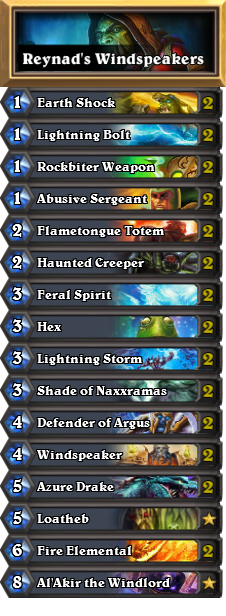
Initially, my plan was to talk about Kolento’s [card]Reincarnate[/card] shaman here but Reynad had a better offer – his double [card]Windspeaker[/card] build from DreamHack Winter.
According to the ever vocal captain of Tempo Storm, this deck had lost one or two of the twenty or something games during practice (and it did beat TidesofTime at DreamHack). I wouldn’t go so far as to call it the best shaman deck of the new meta but between the standard mid-range shamans we’ve all played until our eyes bled and the double [card]Doomhammer[/card] build that has been extensively discussed, praised and criticized by everyone, this is something I would bring to ladder in the last days before GvG to get some excitement out of one of my most favorite classes.
The deck wins on the back of windfury swings from one of its three finishers: [card]Shade of Naxxramas[/card], [card]Fire Elemental[/card] and [card]Al'Akir the Windlord[/card]. The Shades are especially potent as they can sit in hiding until they’re big enough for a major hit. Of course, a windfury shaman cannot go without [card]Abusive Sergeant[/card]s on top of the standard [card]Flametongue Totem[/card]s and [card]Rockbiter Weapon[/card]s, all there to buff up a minion before the [card]Windspeaker[/card]s give it double strike.
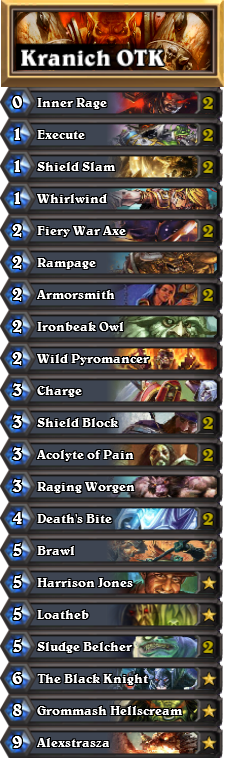
Being primarily a control warrior player, the most exciting part of BlizzCon for me was Kranich’s OTK warrior. You’re reading this correctly – in a time where warrior builds differ by two or three cards at the most (almost always being tech cards), the Korean goes in a completely different direction for his victory plan.
Let’s take the familiar stuff out of the way first. We have all the standard point removal that makes control warrior so good – 1-mana spells, axes and [card]Brawl[/card]. There’s card draw and armor mechanics in [card]Acolyte of Pain[/card], [card]Armorsmith[/card] and [card]Shield Block[/card]. At the end of the curve, it’s no surprise seeing [card]Grommash Hellscream[/card] and [card]Alexstrasza[/card]. So far, so good.
It’s everything else that makes the deck so unique. As the name suggests, this deck is not about outlasting your opponent, it’s about killing him in one blow and that’s where a singleton [card]Raging Worgen[/card] comes in.
The Worgen was a vital part of the OTK warriors of old before [card]Charge[/card] and [card]Warsong Commander[/card] got nerfed but he makes a return here. He’s supported by two [card]Inner Rage[/card]s, a singleton [card]Rampage[/card] and one copy of [card]Charge[/card]. What this means is that if you have all of that in hand, the Worgen can hit for 24 damage on T8. Let’s say you’ve swung a few times with your axes and suddenly your opponent is dead.
I would’ve given you a breakdown of this deck’s ladder performance, but I still haven’t found the courage to test it out.
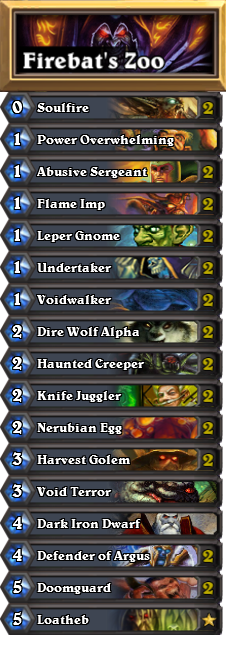
Warlock is where I gave up on trying to find something cool. After over 100 hours of stream and tournament footage skimmed, all I kept seeing were the same standard warlock decks. I truly hope that GvG will bring more variety to a class that has grown staler than hunter, but until then, in the spirit of that one famous photo I will finish the article with this:
There used to be cool decks here. Now there’s Zoo.
At the end of the article, we'd like to remind all our readers that blind netdecking will never yield fruitful results. Climbing the ladder is about understanding and countering a dynamic metagame as well as getting proficient with a certain class, or deck or playstyle. Get inspired by what the pros are playing but be ready to tune each of these decks to your liking and if the metagame requires it.