|
|
 Savjz
Savjz
Because this is the first time we ever do a feature on GosuRankings, I guess a few words of introduction need be written. Please, do go through the paragraphs below, they are an important guide to what GosuRankings represent, how to read them, how are they calculated and how do they behave within the current state of competitive Hearthstone.
Q: What are the GosuRankings?
A: The GosuRankings are GosuGamers’ official player and team rankings, first established during the BroodWar days of the website. With time, they were linked to more and more disciplines and at the present time, they are among the most accurate player/team ranking systems for Dota 2, League of Legends and since March 2014 – for Hearthstone as well.
In its core, the GosuRankings are a collection of competitive tournaments with varying importance which determine players’ position in the rankings depending how they have performed in the tournaments recorded in the database. As of the time of this article, more than 250 Hearthstone televised tournaments, weekly cups, qualifiers and showmatches have been recorded. Note, that GosuRankings do not take into account ladder results or player’s popularity – it is only tournament performance that matters.
Q: What do you mean by “varying tournament importance”?
A: We believe that like in every sport, different tournaments have different importance. Winning BlizzCon world championship, for example, should yield significantly more points than grabbing a $100 weekly cup. When we create a tournament, we weigh in several factors like prize pool, participating players, format, offline/online, length of tournament and several more.
We also constantly re-evaluate these tournament tiers and adjust future events based on where they stand in the current competitive eco system.
Q: How are players’ rankings calculated?
A: The GosuRankings are loosely based on an Elo system, with few adjustments to have it more adequately fit the needs of the eSports climate. When they compete in tournaments, players win and lose different amount of points, which depends on the current ranking of their opponent (you win more points if you beat a higher-placed player and vice versa) as well as the tournament tier (you win more points if you win a match in highly-ranked tournament).
A couple of mechanics have been implemented on top of that system to make it more accurate. First, inactive players will experience rating decay after a certain number of days with no matches played. Decay brings players closer to the starting 1,000.
In addition, the GosuRankings employ the so called “reliability rating” which is another multiplier that affects inactive players. The reliability rating starts at 1.00, gradually decays when a player doesn’t compete regularly, and affects the end Elo rating as well as how many points they will gain/lose on their next match. Players will always want to have their reliability rating at 1.00 which in turn incentivizes them to compete more often.
Q: You mentioned something about Hearthstone competitive climate. What the hell do you mean by that?
We’ve been monitoring the competitive Hearthstone scene since early January when we decided we definitely want to make GosuRankings a thing. For these past sixth months of tournament backlogging, talking to players and observing the game in general, we’ve found out several bullet points worth listing down:
- Hearthstone – like most card games – is a much more volatile game than other eSports disciplines. The random element means that at any point of time, the best player can easily lose to the worst player. This will never happen in StarCraft 2, for example, where a Jaedong simply won’t lose to a bronze leaguer. As a result, it is difficult for Hearthstone players to maintain a steady win rate and their Elo often has big drops or rises, larger than the players in other disciplines.
- The majority of the competitive scene is still composed of weekly open tournaments and those are low-ranked by default. Although we're getting more and more high-paying tournaments, those of which going into the five figures are still a handful. This results in two things:
- The GosuRankings experience a major sway after every major tournament. Sometimes this shift looks bigger than it should, but that’s a direct consequence of the state of the scene
- The discrepancy in the number of weekly and big tournament leads to having a lot of players between 1,000 and 1,100 rating since there aren’t many opportunities to gain points in bulk. This in turn results in big fluctuations in this range after every single weekly cup which will never happen in eSports with more developed competitive scene and should stop happening in Hearthstone after a while
- With all that in mind, do note that at this point, the Hearthstone GosuRankings should not be read literally. There will never be a HS player ranking which will accomplish that, because of the nature of the game. Instead, treat them as a basic outline of who the good players, factoring in their all-time records and current performance.
Q: What's next?
As we wrote in the last edition, we're starting to pay a closer look to the Asian scene. We already have the CN vs KR Masters tournament - the best paying Hearthstone event to date with a total of $54,000 - and we've also backlogged the Korean qualifiers for WEC. On our list of tournaments to backlog is also the SEA vs CN Challenge which was held end of June and offered $6,300 to eight participants. This should help us rate the SEA region better and add even more games to the Chinese players' accounts.
Next on the horizon will be covering the Chinese qualifiers for WEC as well as the preliminaries for BlizzCon world championship whenever they are scheduled.
In July, we also took time to revise our tournament ranking policy. Our goal was to establish a unanimous system to rate future tournaments with as strict set of rules as possible so that our coverage crew has clear-cut guidelines when approaching an event, not having to wonder how to weigh this or that.
One notable "victim" of the revised rankings are the Hearthstone showmatches, who will now be ranked significantly lower, regardless of their prize pool. Although our crew greatly enjoys all the Kings of the Hills and DKMR Invitationals, in the end of the day these are not proper tournaments per se and should be ranked lower.
As noted above, the current GosuRankings are the result of more than 300 events, dating as far back as October 2013. We’re aiming to have as complete scope of tournament as possible and thus have logged in big tournaments like DreamHack and SeatStory Cup, online events like Tavern Takeover, weekly open cups such as GosuCup and NESL, as well as showmatches like Deck Wars and King of the Hill. Every month, more than 50 tournaments are added to our database, making it more accurate each time.
NOTE: The rankings displayed below are as of August 4th.
Global rankings and top 5 recap
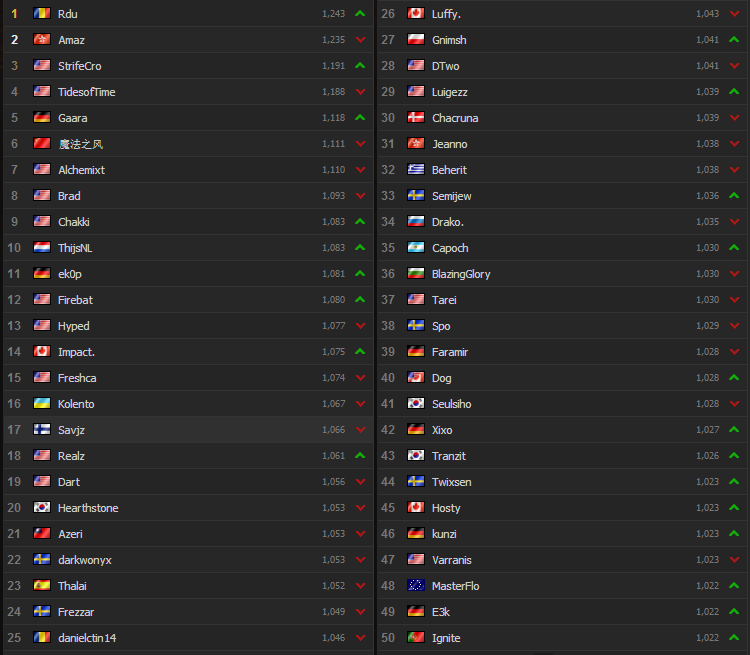
A quick note before we start the worldwide rankings analysis: Usually, we screenshot the rankings pages on the very first day of the month but this time we decided to postpone that a little to include all the great Hearthstone action happening at the start of August, including the Prismata Cup playoffs (who, technically, were played in July but streamed in August) and the WEC North American qualifiers. Since we knew this article would be live well into August, we thought that including the two bigger most recent tournaments would make for a fresher analysis.
The top two spots of the GosuRankings once again feature Rdu and Amaz, who continued to be some of the most consistent players in all of Hearthstone. After finishing June with a silver medal from WellPlayed Cup,  Dima "Rdu" Radu did not slow down one bit. Proving to the naysayers that he can perform well in any tournament format, the Romanian abandoned the high-tier invitationals and attended a couple of weekly cup events, known for their gruesome formats and high volatility. The result: a championship from ZOTAC EU #23 and a second place finish at GosuCup #17.
As if this was not enough, Rdu traveled to Shenzhen, China to compete at the first big IEM event for Hearthstone and came out fourth after losing to his rival Amaz. He then had a more or less silent second half of July before he opened the first days of August strong with a first place at the WEC European qualifiers. The kid is currently at 78% all-time win-rate with 86% peak in July. Impressive? That's mildly putting it, yes.
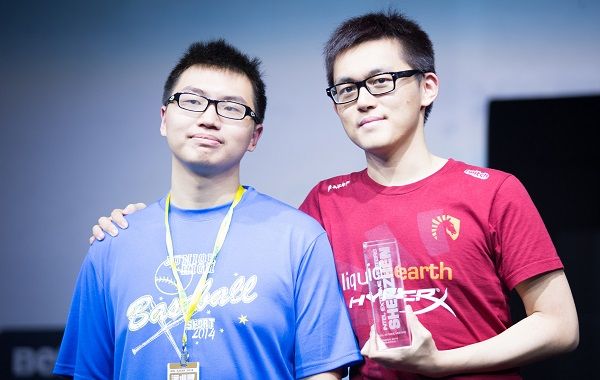
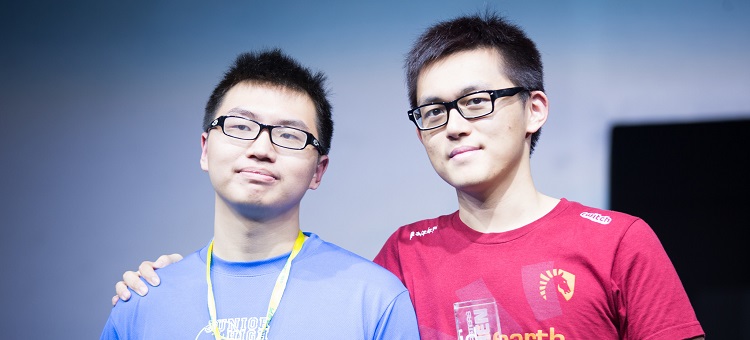
Just eight points behind Rdu is Liquid's poster boy  Jason "Amaz" Chan, who also had a very strong July. Amaz didn't play a lot of games last month but the four games he did play brought him an IEM Shenzhen championship and solidified his top GosuRankings spot at the time. In fact, Amaz would still be holding the throne if it wasn't for his 0-2 ousting at WEC North America.
Third in the rankings is  Cong "StrifeCro" Shu who just refuses to fall out of the top three. Although he's not in the top form he displayed in the early days of Hearthstone, StrifeCro nevertheless remains admirably consistent. He finished top 8 at IEM Shenzhen, top 4 at WEC NA Qualifiers and top 6 at Prismata Cup and remains in the top 5 of best performing players in Gentlemen Cup. However, he's now below the 1,200 rating and his title of #1 North American player can very well be stolen...
...By that guy, Drew "TidesofTime" Biessener. Ever since he came out of the comfort of NESL weekly tournaments and KOTH events, Tides has been rocking the online invitational tournaments. In June, he conquered WPC by prevailing over MYM powerhouse Rdu. In July, he 4-1'd the Prismata Cup swiss round which led to a top 4 finish at the playoffs, losing in the semi-finals to his team-mate Gaara after an insane five-game series. Additionally, Tides was manage to come out first in the WEC NA qualifiers, beating players like Brad, Reynad, StrifeCro, Firebat and Alchemixt, which rocketed him to #4 in our rankings.
Finally, at number #5 we have  Petar "Gaara" Stevanoic. After his victorious run at DreamHack Bucharest and several successful showmatch appearances, Gaara kind of disappered from community's radar. In late June, he traveled to France for the Millenium Cup where he took top 4 but that was it - after that, Gaara was gone.
Then, in the last days of July, the Tempo Storm player returned for what was a flawless run through Prismata Cup. In one of the most competitive invitationals ever held in the game, Gaara went 19-9 through Forsen, Ignite, Dog, TidesofTime and Brad and returned to his rightful place - the higher echelons of the GosuRankings.
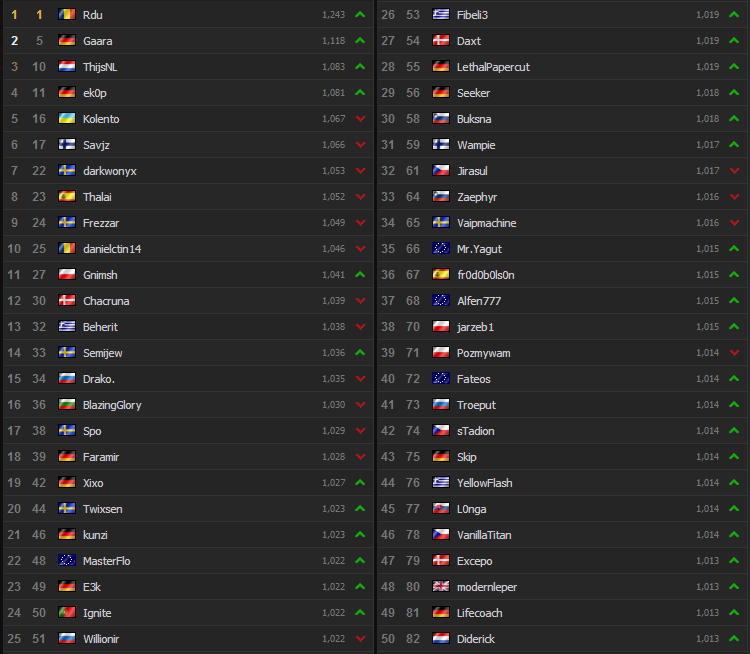
For the longest time, Savjz was considered as the constructed king of Hearthstone. He was the first long-reigning champion of IHearthU's King of the Hill, setting a four-win record which took a while to beat. In April, he won the EU vs CN Masters qualifiers and in May he added $11,000 to his account after winning OGN Invitational and placing second at Tavern Takeover 1. He was the face of Curse Gaming and was leading the star-laden roster of Darkwonyx, Alchemixt and Kitkatz.
Then everything collapsed. The loss at the Tavern Takeover finals were the prelude to a terrible losing streak that chased him through a 0-3 to Admirable at Deck Wars, first round elimination from Tavern Takeover 2 after a 1-3 to Alchemixt, a disastrous 1-4 ousting from DreamHack Summer following losses to Ek0p and Reynad and another first round elimination at WEC Europe afte two 2-3's to Rdu and Semijew. The king was looking out of shape and was no longer in the limelight, his place taken by the new tournament powerhouses Rdu and Amaz.
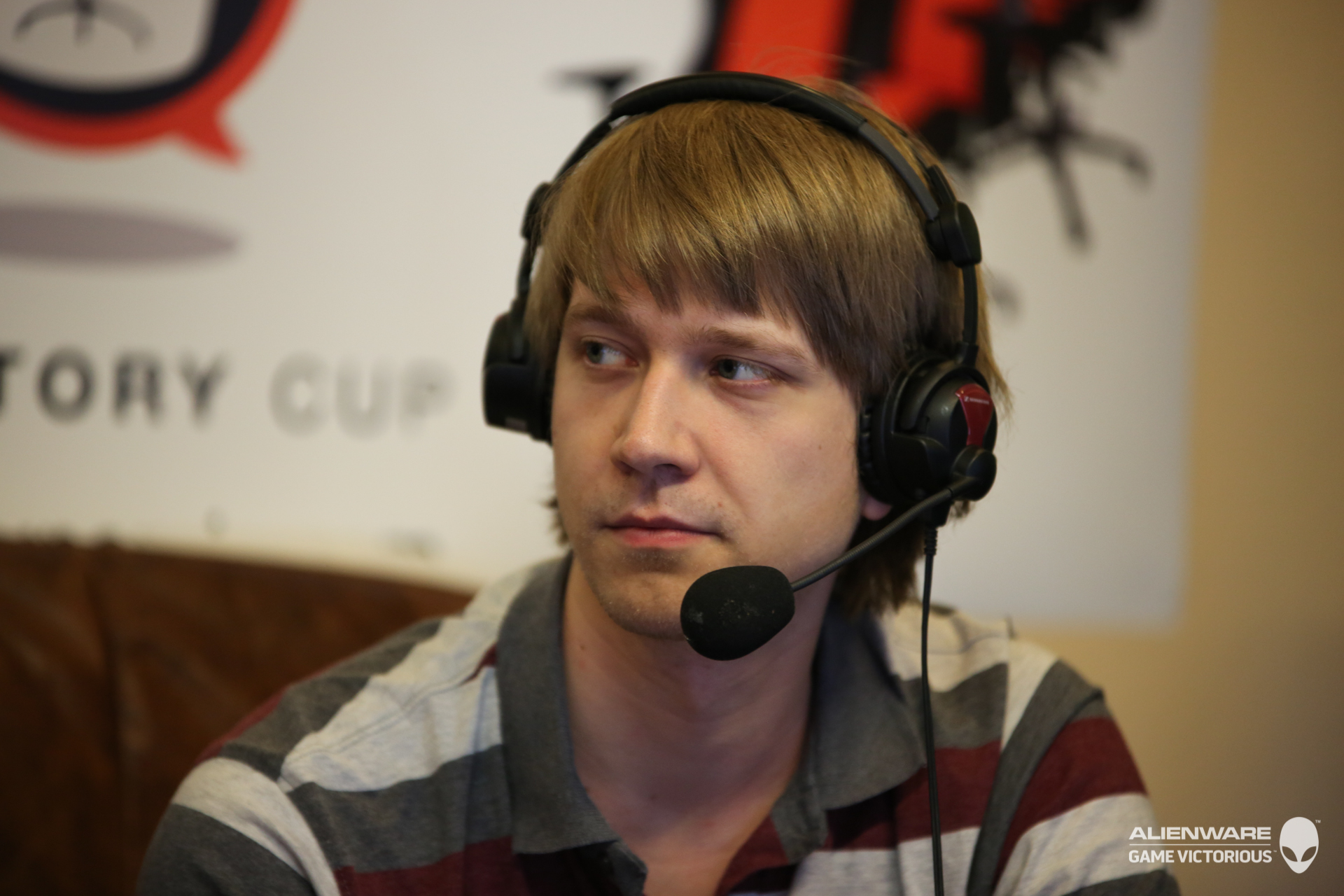
At the end of July, Savjz attended the Finnish qualifiers for IeSF with hopes to recover his former glory. Although a local tournament with a relatively low-profile, the qualifiers featured names like Jamuli, Jirachie and Wampie, all seasoned in weekly cups and no stranger to competitive Hearthstone. This wasn't going to be a walk in the park for the ex-Curse player.
Only, it was. Savjz exitex his group without losing a series and then proceeded to beat his compatriots to the ground come the playoffs. At the very end, as he stood over the body of Wampie, Savjz had pinned a 13-2 record in the tournament overall, grasping a seed into the IeSF grand finals for November.
Between then and now, Savjz also managed to score a few showmatch victories, proving there's still life in him. His return to IHearthU's King of the Hill resulted in a 4-1 slaughterfest against the record-holding nine-win king ThijsNL and now the Finn will try beat Korean player Tranzit to score his sixth win in the showmatch series overall. In addition, Savjz also secured a spot in the Deck Wars S2 finals, edging a hard-fought series against former team-mate Darkwonyx, making for a seven-game win-streak since the start of the IeSF qualifiers. Savjz might still be out of the top 10 worldwide, but he's getting there!
2. The new North American challenger
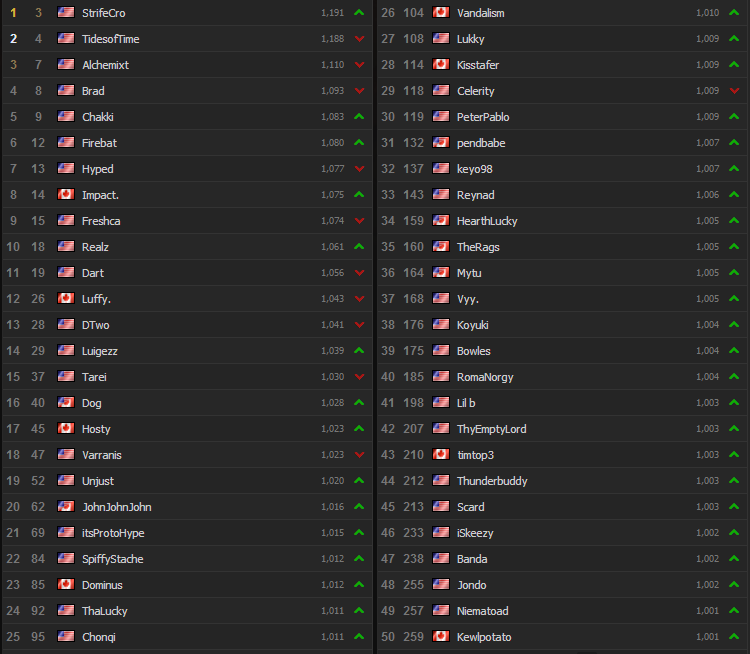
We briefly spoke about TidesofTime in the top 5 overview but honestly, he will be the player to watch for in August, mostly because he's so very close to overcoming StrifeCro on the top of the NA region.
What brought Tides his successes was his ability to diversify his play and bring unorthodox decks to the table, showing he's not afraid to step outside the meta and surprise his opponents. His Warrior control decks, for example, would feature double Faceless Manipulators, Gnomish Inventors instead of Azure Drakes, Defenders of Argus, or even Leeroy. He would bring a double Lava Burst Bloodlust Shaman to a tournament environment. Or a Priest deck despite not being known for an Anduin player. Or, well, play extremely standard, rocking the cookie cutter builds just as well as he handles his own tweaks.
By the time this article is published, TidesofTime would be just three points below StrifeCro, meaning he's a showmatch victory away from overcoming the NA king and putting himself in the top 3. The question "Can he do it?" is also moot at this point: In his last 20 games, TidesofTime is at 15-5 or 75% win-rate. His peak in July was at 80% and his all-time record is none too shabby either at 67%.
Unless he falls into a bad losing streak or StrifeCro suddenly explodes with great results, by the end of this month we'll likely be looking at the new ruler of the NA rankings.
Unfortunately, the GosuRankings still doesn't allow us to adequately track team rankings. Our future plans include an algorithm which can calculate that based on members' individual performances (i.e. every win a player scores helps not only him but his team as well) but for now this is still uncharted territory.
Nevertheless, we believe ranking teams is fun even if there is no mathematics to support it. Last month, we tried separating teams into two tiers but this month we're trying something different. Instead of doing an editorial power rankings, we've calculated the average Elo of the most popular teams and rating them this way.
Do tell us which of the two you prefer better!
NOTE: Only teams with three or more ranked players have been listed. Teams with Elo lower than 1,000 are omited.
| # | Team | Points | Diff. | |
|---|---|---|---|---|
| 1. |  | Tempo Storm | 1097,25 | +2 |
| 2. |  | Cloud 9 | 1074,00 | -1 |
| 3. |  | Meet Your Makers | 1064,28 | -1 |
| 4. |  | Team Coast | 1050,67 | N/A |
| 5. |  | Don't Kick My Robot | 1031,33 | - |
| 6. |  | Managrind | 1021,60 | - |
| 7. |  | Copenhagen Wolves | 1015,67 | N/A |
| 8. |  | Innovation | 1007,33 | -1 |
| 9. |  | eSuba | 1007,20 | +1 |
| 10. |  | vVv Gaming | 1005,80 | -2 |
Amaz/Azeri photo by Helena Kristiansson / esportphoto.com. Savjz photo by GosuGamers.