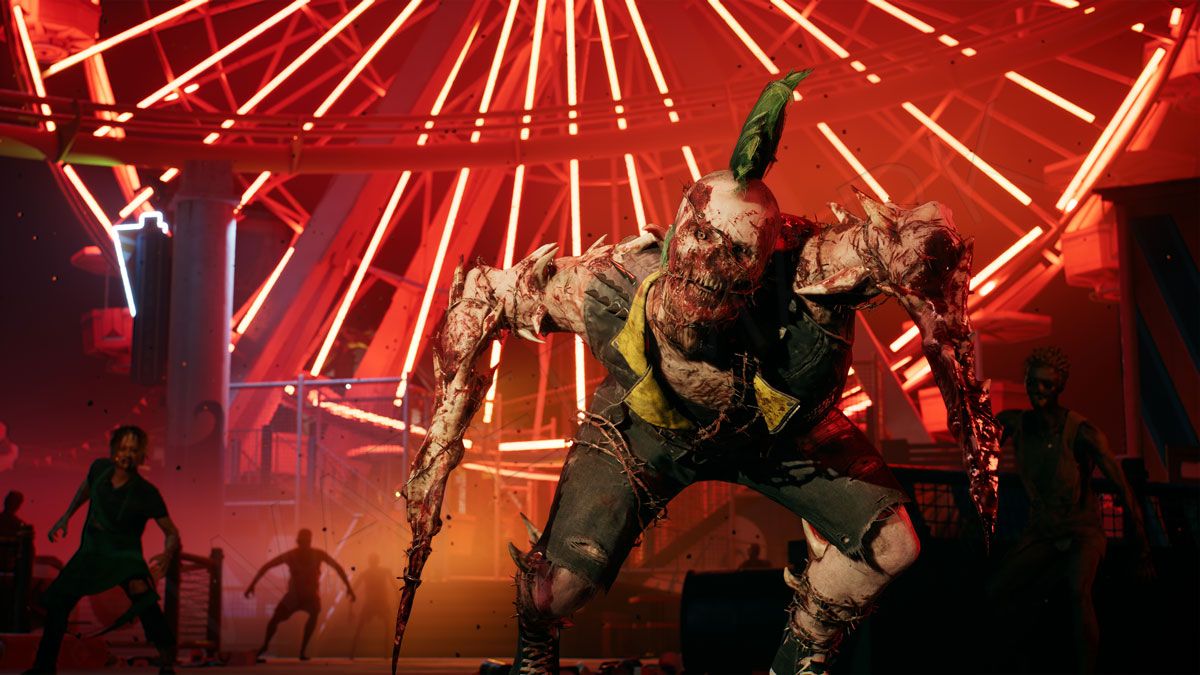
We interviewed Dead Island 2’s developers about the game’s gore system, Hollywood-focused story and long journey out of development hell.
The fact that Dead Island 2 is playable at all seems like a minor gaming miracle, considering that the sequel has been infamously stuck in development hell for eight whole years. The project shifted studios twice, going through multiple iterations before finally settling down at Dambuster Studios. Dambuster started from scratch with the sequel, building it from the ground up with a heavy focus on sunnyside Los Angeles as a setting, and a complex gore system as its main attraction.
We spoke to Dambuster’s technical art director Dan Evans-Lawes and design director Adam Duckett about Dead Island 2’s long journey out of development hell, disgustingly detailed gore and surprisingly detailed environments. Here’s what they had to say.
Note: this interview has been condensed and edited for the sake of clarity.

Could you share a little more about what your role is at Dambuster and what you worked on in the game?
Dan Evans-Lawes: I'm the technical art director. So I was involved really heavily with the lighting, the gore tech, that sort of thing. But primarily the gore tech. That was my baby for the project.
Adam Duckett: I'm the design director of Dambuster Studios. My role is split between world design, level design and game mechanics.
Dead Island 2 makes really smart use of its environments to tell jokes. The influencer nest for example, had me do a double-take when I noticed a whiteboard with an ‘apology video’ script written on it. How did that level of environmental detail come about?
Adam Duckett: So, at the start of the project, we were really keen to add quality into the environment and to build our spaces at a size where every inch of the environment could be explored. So we didn't want to do sprawling copy-pasted environments with large areas of nothing. We wanted all our locations to be super detailed. Once we made that decision, we could really focus on the individual interiors, the individual spaces. We had conversations about who would live there, the types of personalities, the types of things they would have in their houses. The team, the artists, the environmental artists, the narrative designers just sort of ran with that concept, and some of the stuff they've come up with is absolutely fantastic.
Dan Evans-Lawes: It was also driven by the gameplay because obviously, you're fighting zombies. Our zombies are very, very destructible, as you've probably noticed, and so we couldn't have thousands of zombies. So it's always going to be you and a reasonably-sized horde of zombies, and that gameplay just works better in a smaller space.
A huge part of what makes Dead Island 2 so addictive to me is the flesh engine. It’s so disgustingly detailed, and that speaks to me as a horror fan. How long did that take to implement in the game?
Dan Evans-Lawes: It was actually quicker than you'd think. A fairly final version of it has been in since very early on in the project. Obviously, we improved it as we went along a bit, but there was always the basic principle of: hit a zombie and it will get hit exactly where you hit it. And then we see internal organs inside and they can be destroyed. That's been in for what, three years? Yeah, three and a half years. Something like that. It's got better.
Most of the work after that point was to make the gameplay systems interact with it in a way that worked nicely. Because early on, you'd hit a zombie and get some damage. And then you'd get a Crusher and you'd have to hit it a few times, and it would end up being a giant walking skeleton. That’s a bit too far, right? It doesn't quite work, because where’s its muscles? So we had to make sure that the damage scaled sensibly, so that it felt like you were doing the appropriate amount of damage for how much health a zombie had.
Adam Duckett: We've got to a really good state now as well. If you turn the HUD off, the amount of damage on the zombies is an accurate representation of how much damage you've done to it as well, so it's a really good indicator for gameplay.
How did the team go about picking and choosing which parts of Los Angeles would feature most prominently in the game?
Adam Duckett: We looked at LA through the lens of Hollywood, choosing locations that you might know from the movies and, internally, we started calling it the postcards of LA. They’re locations you might see on a postcard. We had others that were in discussion too, but once we started to really hone in on the most iconic locations, these are the ones that popped. Even if you've never been to LA, you are going to recognise the locations of the game.

Dambuster came into this project in 2018. What was the main thing you wanted to bring to this sequel upon inheriting it, and what did you choose to keep from the older years of development, if anything?
Adam Duckett: We're quite lucky, because we got to start again from scratch when we were given the opportunity to work on a demo. It's a 100% Dambuster game. And really, it was about focusing on three key areas, like it was zombies at the core, brutal melee combat and postcard LA locations. So we're firm believers in making sure that a game isn't trying to do too much, and focusing on quality over quantity. For us, the IP is all about zombies. It's about making a zombie game for zombie lovers.
Dan Evans-Lawes: It's kind of a simple game. It's just that fantasy of ‘I want to go and slice and dice shitloads of zombies, and have a lot of fun doing it’. I think it's a simple pleasure. Which is what we aim to achieve.
What was your favourite part of working on the game?
Dan Evans-Lawes: I've never worked on a zombie game before. But certainly as a teenager, I absolutely loved zombie movies. I've watched so many. I mean, I can't tell you how many times I've watched Return of the Living Dead. I was like, “this game has to be the greatest game out there.” You know, and gory in a fun way. I think we achieved that, so I'm really proud of that.
Adam Duckett: For me, it's the combat sandbox. It's the symphony of all the systems working together so you can kill zombies in interesting and innovative ways. So that's the weapons, the curveballs, the skills, the highly-detailed environments, the rich narrative, but also the physical isolation of the world and the amount of the environment that players can use against the zombies. It's that kind of combination, that holistic approach to all our features. That just results in absolute chaos, particularly towards the later end of the game. And that is, it's really as a designer, it's really rewarding when all your systems come together to craft a fun and focused experience.
The combat, flesh engine and different enemy types all seem to work in tandem to create this really gory gameplay sandbox. What was it like to come up with all these different aspects to combat and balance them so they wouldn’t be overwhelming?
Adam Duckett: If you boil it down to the damage types that you're applying to the zombies, that was really our starting point. We wanted to melt them, we wanted to burn them, we wanted to shock them, slice, dice, bludgeon, but then have everything tie in too. So if you take electricity as an example, you can weaponize it by attaching it as a mod to your weapon. But you can also rip out car batteries and throw them. So on your curveball slot, you have a chem bomb, which can douse enemies, and follow that up with electricity or a shock bomb. Those elements are designed in a holistic manner to complement that one aspect.
And I think another good angle is the zombies themselves. Firemen are immune to the elemental damage, which is another piece of the puzzle. The shocking walkers and runners which are like electricians will spark electricity. And if you can actually utilise them to your advantage by drop kicking them into a swimming pool, that will discharge their electric electricity. So yeah, it's the combination of all these features.

There is an inherent silliness to being able to bash zombie heads with baseball bats and fighting mutated zombie brides at a wedding venue. But then there also happens to be moments of seriousness in the main campaign, where we dig into these characters’ psyches a little bit. How do you maintain that balance between levity and drama?
Dan Evans-Lawes: I think we've always wanted the game to feel fun, and not too heavy. That was partially down to the gameplay, in terms of how much ridiculous violence you would be inflicting. If we made it very realistic, and the tone was very dour, then it could just get depressing and disgusting, and make you feel like a monster. That isn't what we wanted to do. We wanted that element of silliness running throughout, but obviously, as far as the characters in the world are concerned, this is what's going on. People are getting killed.
The world is kind of hyper stylised, and although deaths are going to register in this universe, maybe it's not going to immediately traumatize them for ages, and they’re going to be crying for the next six minutes of this cutscene. It's a balance, right? You can't be entirely flippant because all this violence is happening. Because to the characters in the game world, it's real, so they have to have some sort of reasonable reaction to it. From the player's perspective however, we want it to feel fun.
Adam Duckett: Daniel used to say at the start of the project where, if you're trying to tug on the heartstrings of the player, and then straight after that you go and strap flamethrowers onto a pickaxe and run outside, the tonal inconsistency there will be jarring. I think we've got a really good balance between, as Dan said, the moments of sincerity, but also just the fun over-the-top sandbox adventure.
Dan Evans-Lawes: Yeah, and I think if you look at other other zombie games that have done a very serious and sort of dark story, it can definitely work, but I think you have to keep the gameplay in a place where it doesn't fight that. We definitely wanted to go pretty extreme with the gameplay, pretty extreme with the kind of violence and the ridiculousness of that, and so we had to keep the story in line with that because otherwise it's just too much tonal dissonance.