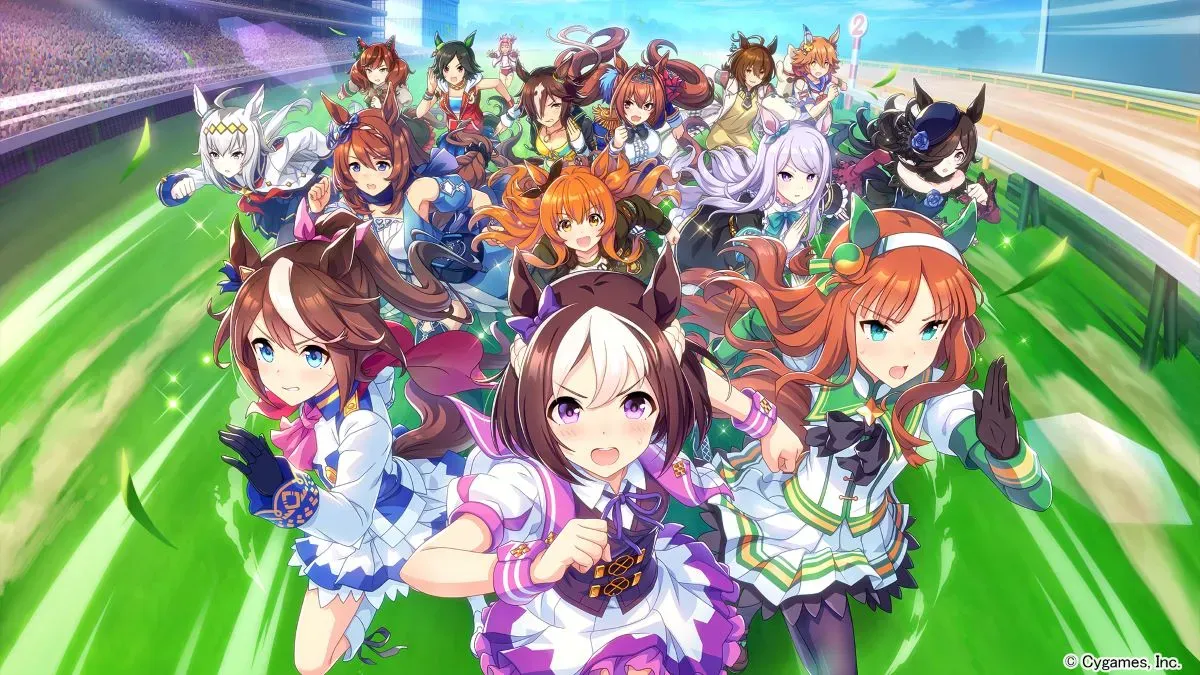
If 2026 is the Year of the Horse, then 2025 may very well be the ‘Year of the Horsegirl'.
When the year 2025 started, I barely knew anything about the Japanese horse racing scene. But thanks to Umamusume: Pretty Derby, I will be entering 2026 with the ability to yap about many of Japan’s greatest race horses, as if I’ve been watching races all my life. If the year 2026 is the ‘Year of the Horse’ according to the Chinese zodiac, then the year 2025 may just go down as the ‘Year of the Horsegirl’.
Indeed, the cultural impact of Umamusume hit me–and many others–as hard as a post-race dropkick from Gold Ship.
In case you’ve been living under a rock, Umamusume: Pretty Derby is a gacha game developed by Japanese developer Cygames where you train and race the titular umamusume (literally meaning horse girl in Japanese) then watch them put on cute idol concerts after every race. Each character in Umamusume is named after and closely based on an actual Japanese race horse. And yes, all umamusume are anime horse girls, regardless of whether the horses they are based on were stallions or mares.
While the Umamusume franchise is centred around the game–which was originally released in Japan back in February 2021–it has since grown into a massive franchise with spinoff manga, anime, movies, and more. Following the release of the game’s global version in June this year, Umamusume has taken the whole world by a storm.
The whole premise of the Umamusume franchise is pretty absurd, even by the standards of gacha games or anime. So, if you’re wondering how this franchise about horse girls became a global cultural phenomenon, allow me to satisfy your curiosity by walking you through how I found myself deep in this rabbit hole.
Putting the ‘Pretty’ in ‘Pretty Derby’
It may not look like it at first glance, but Umamusume as a franchise holds a deep respect and appreciation for the sport it is based on. The various umamusume you see may look like anime girls–just with horse ears and a tail–but every aspect of their design and characterisation pays tribute to the actual horses (and at times their jockeys and/or owners) and their legacies.
For example, take my favourite uma, Gold Ship. Gold Ship in Umamusume is a tall, gray-haired girl who is well-known for her chaotic swings in mood and motivation, as well as her tendency to play pranks on others and dropkick the player after winning races. Most memes about Gold Ship depict her doing “anything but training” and committing wanton acts of violence from out of the blue.
Cygames didn’t just pick those design choices at random, Gold Ship in real life is also known for his eccentric personality. While he is a fearsome racer when locked in, with 13 victories out of 28 races, he also has some dramatic losses such as the infamous ‘12 Billion Yen Incident’ during the 2015 Takarazuka Kinen where he finished 15th after rearing up just before the starting gates opened.
Gold Ship’s unpredictable results led some fans to believe that his performance largely depended on his mood in any given race, losing due to disinterest and winning once he actually took things seriously. One of his jockeys would even reportedly pray before every race that he would just run normally.
The signature racewear worn by umas during races also capture aspects of their real-life counterparts.
In the case of Gold Ship, her red dress is based on the red racing silks worn by the real-life horse’s jockeys. She also has six golden buttons on her dress which represent the six G1 wins of her real-life counterpart, while the red ribbons on her boots are based on the ribbons tied on the tails of horses to inform others of their status. A red ribbon means a horse is prone to kicking, by the way. The real-life Gold Ship loved kicking horses and people he disliked, though I quite like how Umamusume made it so that uma Gold Ship kicks people as a form of endearment. Only sometimes, though.
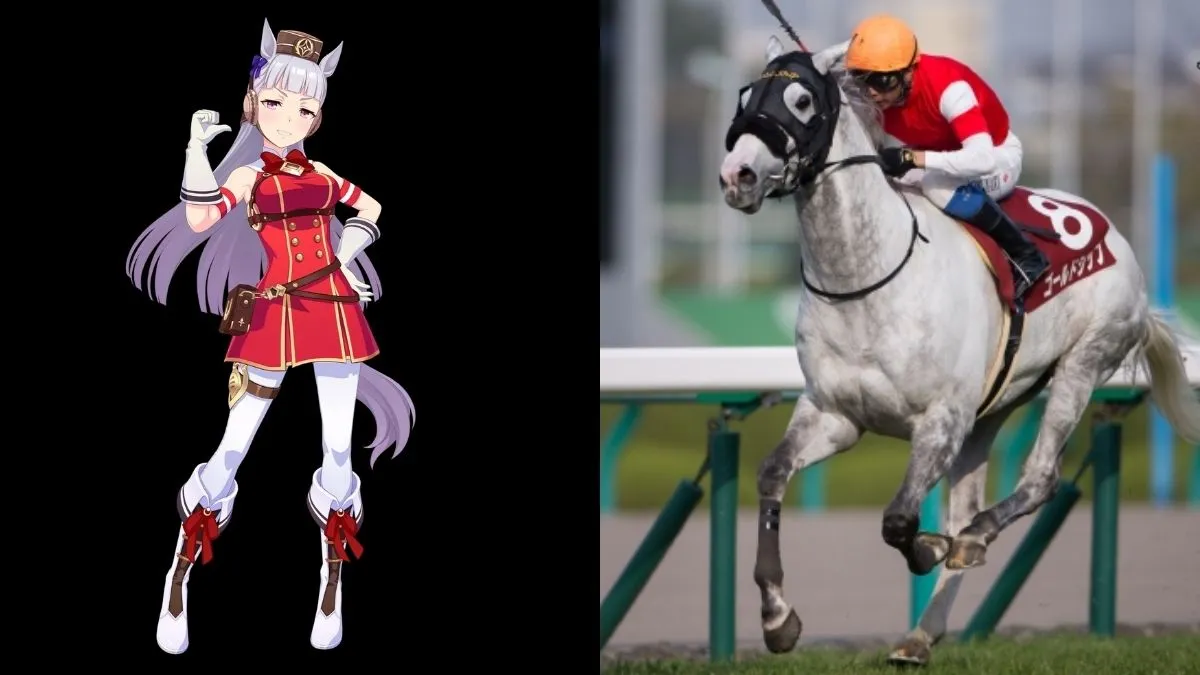
Gold Ship in Umamusume: Pretty Derby (left) and real life (right) (Images: Cygames, JBIS Search).
Of course, Umamusume’s tribute to the racehorses that are at the heart of it all extend beyond how the umas are designed and characterised.
In gameplay, while the player is free to run the uma they are training in any race they want, each one has certain aptitudes for running styles, as well as the length and surface of tracks they run in. They also have ‘Goal Races’ that they must run and place well in for their career to progress.
Gold Ship, for example, is an ‘End Closer’ that runs at the back of the pack for most of the race before surging to the front towards the end of the race, and is best suited for medium and long-distance races–just like her real-life counterpart. One of Gold Ship’s Goal Races is the Takarazuka Kinen, a race her real-life counterpart won twice in 2013 and 2014 before the 12 Billion Yen Incident in 2015.
It is also worth noting that not all umas have careers that will just have you try to retrace the steps of their real-life counterpart, others will have the player try to rewrite history.
For example, Tokai Teio in Umamusume aims to be an undefeated ‘Triple Crown’ champion by winning the Satsuki Sho, Japanese Derby, and Kikuka Sho just like her idol Symboli Rudolf. In real life, Tokai Teio was unable to achieve the feat. While he won the Satsuki Sho and the Japanese Derby, he was unable to race in the Kikuka Sho due to a leg injury. And the reason why Tokai Teio in Umamusume wanted to follow in the footsteps of Symboli Rudolf is because, in real life, Tokai Teio was sired by Symboli Rudolf.
There are also many examples of Umamusume characters having close relationships because their real-life counterparts were related by blood. My favourite example of this by far is the so-called ‘Gold Clan’ of umas, which include Gold Ship and his real-life half-siblings Orfevre, Dream Journey, Nakayama Festa, and Fenomeno, as well as their father Stay Gold.
The ‘Horse’ behind the ‘Horsegirl’
However, by far the best example of Cygames’ dedication and respect to the real-life horses the Umamusume franchise is shown by how they handle their respective legacies.
Another one of my favourite umas is Rice Shower, a timid umamusume with low self-esteem and an inferiority complex. Despite her name coming from the tradition of throwing rice at newlyweds for good fortune, Rice Shower thinks that any and all misfortune befalling those around her is entirely her fault.
The reason why Rice Shower is depicted this way in Umamusume is because her real-life counterpart was a very tragic figure.
The real-life Rice Shower was nicknamed ‘the Black Assassin’ for stopping two very popular horses from achieving historic feats. In 1993, Rice Shower prevented Mihono Bourbon from winning the Triple Crown by defeating him in the Kikuka Sho. The next year, Rice Shower then denied Mejiro McQueen a third-straight victory in the Spring Tenno Sho. As a result, Rice Shower was portrayed as a ‘heel.’
Rice Shower didn’t win any significant races after the 1993 Spring Tenno Sho until the race’s 1995 edition, which occurred shortly after the Great Hanshin Earthquake. Unlike his past victories, Rice Shower was actually cheered on for this win, as he was seen as a source of inspiration for those that were struck by the disaster.
Rice Shower’s owners originally wanted to retire him following his win in the 1995 Spring Tenno Sho, but decided to race him one last time in that year’s Takarazuka Kinen in order to improve his prospects as a breeding stallion. Tragically, Rice Shower sustained a leg fracture during that race, and the damage was so severe that he had to be euthanised on the track.
While he was hated for his victories during his career, Rice Shower would eventually turn into a beloved figure following his death.
In both the main story of the Umamusume game and Season 2 of the anime, Rice Shower was also hated by fans for defeating Mihono Bourbon and Mejiro McQueen. But that fatal accident in the 1995 Takarazuka Kinen doesn’t happen in Umamusume. Instead, Rice Shower learns to get over her fears and insecurities to find the joy in winning she has long been searching for. This aspect of her character growth is depicted beautifully in her song ‘A Little Prayer’, which I admit never fails to get my eyes all misty.
Beyond the racetrack
Wanting to know more about the real-life horses that inspired my favourite umas has led me into quite the rabbit hole. I watched their real-life races (shoutout to the URA Umamusume Racing Archives channel on YouTube); learned about all the little quirks and personalities of the horses; their relationships with their rival horses, jockeys, trainers, and owners; and even looked at who their ancestors and descendants were as well as how their respective careers panned out.
After getting into Umamusume, I’ve included Umamusume songs in my daily playlist (my Top 3 are Ms. Victoria, Tracen Ondo, and U.M.A. New World) and started watching horse races both past and present for entertainment whenever I eat. I watched this year’s Japan Cup and Arima Kinen via livestream, and those had me at the edge of my seat. I now plan to visit Japan in the future to watch some races live. I know for a fact that I’m not the only one who suddenly found themselves so invested in this franchise, and in horse racing in general.
Beyond Umamusume’s sustained success in Japan, the explosive launch of the game’s global version, and burgeoning anime portfolio (Cinderella Gray and Beginning of a New Era are arguably the best sports anime right now), perhaps the best example of the franchise’s cultural impact is how it has extended to the real world.
In July, a donation drive to gift fresh ryegrass to Haru Urara–a beloved race horse known for losing 113 races during her career and also inspired an Umamusume character–resulted in the donation website crashing due to an overwhelming flood of support led by Umamusume fans. Later in the year, Umamusume fans also greatly helped in raising thousands of dollars to fund renovations for stables that house retired race horses who inspired Umamusume characters. These include Northern Lake Farm, which houses Meisho Doto, and Versailles Resort Farm, which houses Tanino Gimlet, Wonder Acute, Transcend, and Eishin Flash.
Umamusume fans, many of them cosplaying their favourite characters, have also flooded races all over the world. Cygames has also been making its presence felt, having recently become the main sponsor for the G1 American Oaks race. Heck, Umamusume fans have even started rooting for the Denver Broncos, an American football team, simply because its logo and mascot is a horse.
Even now, I admit that I’m still somewhat surprised by how quickly and deeply I’ve become emotionally invested in Umamusume. When Grass Wonder, Haru Urara, and Gentildonna died earlier this year, I admit that I was devastated upon learning of their deaths and admittedly still had tears in my eyes while writing their obituaries for our website. I didn’t even know they existed before I got into Umamusume, and yet there I was grieving as if I had lost a beloved friend.
And I guess that’s really the best thing about Umamusume. If you’re willing to jump in, you’ll learn about the colourful world of Japanese horse racing, get to know so many wonderful horses, and maybe even get invested into actual horse racing. Sure, the sport itself is not without faults, but the franchise has inspired a real drive to improve the welfare of the horses themselves.
Umamusume also made me (very poorly) dance Umapyoi Densetsu at a Christmas party. Fun fact!
If you've gone down the rabbit hole of Umamusume: Pretty Derby yourself, you can dive a little bit deeper by checking out Umamusume-themed merchandise on Playasia.com here.