Fresh insights from Valve put the system’s pricing strategy into sharper focus.
Valve’s return to the living room is gathering momentum, but its latest update has pushed pricing back into the spotlight. The company has confirmed that the upcoming Steam Machine will not adopt the subsidised model used by major console makers, signalling a price point shaped squarely by the current PC market. With hardware costs rising across the board, the announcement has sharpened attention on what players should realistically expect when the system finally launches.
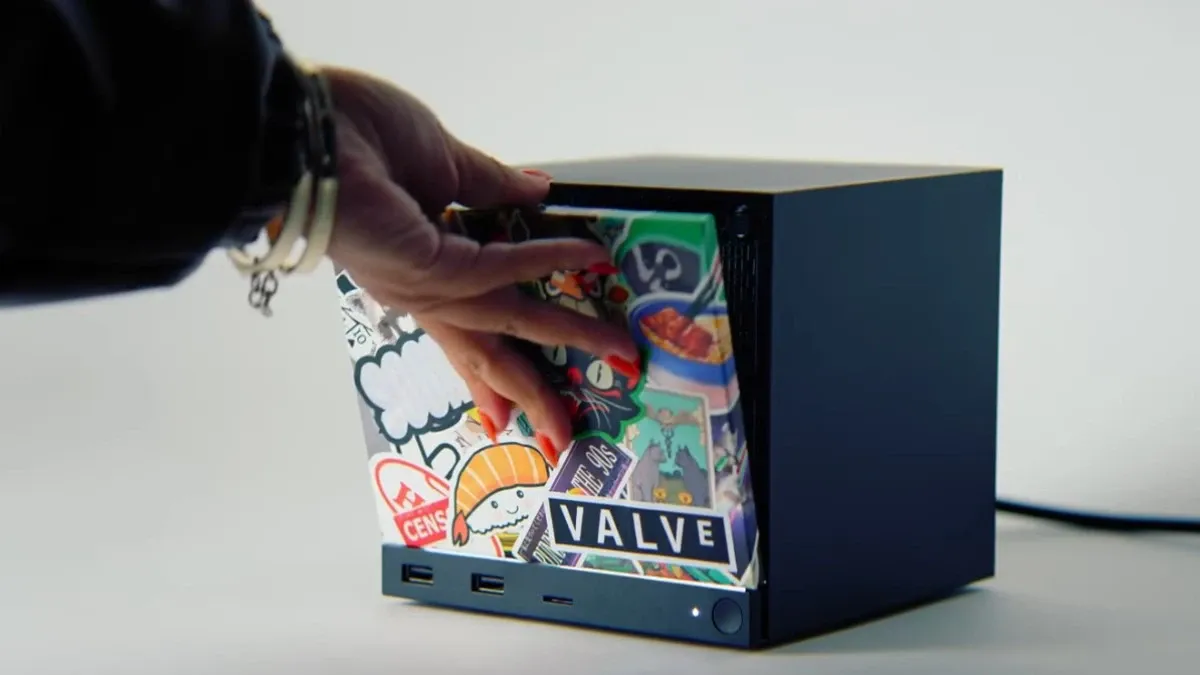
Positioned as a compact, SteamOS-powered PC built for plug-and-play gaming, the Steam Machine aims to outperform most rigs captured in Valve’s hardware survey. Its form factor and design place it closer to a console experience, but the company’s latest comments indicate that its cost will remain firmly tied to PC-building economics.
Valve outlines hardware philosophy and pricing direction
In a recent interview with YouTuber Skill Up, Valve’s Lawrence Yang and Pierre-Loup Griffais addressed the ongoing speculation around the Steam Machine’s price without committing to a number. Griffais began by noting that the system’s GPU performance puts it ahead of most gaming PCs captured in Valve’s own data. As he explained, “We have looked at that number as part of speccing the machine, so it’s possible it’s evolved a little bit over time, but I think ballpark, it’s about there.”
From there, Griffais reiterated that Valve expects the Steam Machine to land within the cost range of assembling an equivalent PC yourself. He told SkillUp that players should think in terms of building a rig with comparable parts, adding: “I think that if you build a PC from parts and get to basically the same level of performance, that's the general price window that we aim to be at.” He also noted that Valve is still refining the figure internally, saying, “Right now is just a hard time to have a really good idea of what the price is going to be because there's a lot of different things… a lot of external things.”
Given that guidance, the system is widely expected to cost above $750; a significant jump from today’s console prices, with the standard PS5 at $549.99 and the Digital Edition at $499.99. Even the PS5 Pro sits at $749.99.
During the interview, Skill Up pressed Valve to confirm whether the Steam Machine would avoid the loss-leading strategy used by console manufacturers. Griffais didn’t hesitate. “No. It’s more in-line with what you might expect from the current PC market. Obviously, our goal is for it to be a good deal at that level of performance.”
He then highlighted the features Valve considers essential to the product’s value; elements that aren’t easily reproduced when building a custom PC. Griffais pointed to the compact design, low-noise cooling, and home theatre-oriented additions such as HDMI-CEC, explaining: “And then you have features that are actually really hard to build if you're making your own gaming PC from parts, right?” He continued, “Like things like, obviously the small form factor and I think the noise level that we achieved or lack thereof is really impressive… But also some integration features like HDMI CEC… all that kind of stuff.”
The engineer also described the system’s wireless design, which includes four antennas and seamless support for multiple Bluetooth controllers, something Valve says is difficult to match in a DIY setup. “More importantly, you can turn on the machine from your controller,” he added, highlighting a convenience usually limited to consoles. According to Griffais, these are the details that shape the Steam Machine as a living room-ready device rather than a simple parts build.
Yang also added a more personal note during the discussion, commenting: “For me one of the benefits of Steam Machine is, I'm someone who used to build my PC in college and I am too old and tired to do that now!”
The interview echoes comments made recently on Linus Tech Tips’ WAN Show, where Linus Sebastian described expressing disappointment that Valve would not subsidise the machine despite Steam’s 30% storefront cut. Sebastian recounted Valve’s reaction after he described a “console price” as $500: “Nobody said anything, but the energy of the room wasn't great.”
He also summarised the machine’s reported specs, stating: “So basically, it's a 7600 CPU and a 7600 GPU… Valve is upfront saying that they are going to be relying on FSR in order to achieve 4K… anyone else would be taking a ton of flak for shipping a game console today with 8 gigs of VRAM.”
The pricing stance has sparked debate among developers as well. Larian’s publishing director, Michael Douse, suggested that avoiding a subsidy may cost Valve more in potential storefront revenue than the additional $200 or so per unit. He described Steam as “essentially a money printing machine,” before adding: “That said it isn't stupid to not sell things at a loss, just peculiar in this case.”
Valve's Steam Machine will be launching in 2026.