Sega does what Nintendon’t.
“Another kart racer,” was my first thought when Sonic Racing: CrossWorlds was announced. But one week later, I’ve found myself glued to it, racing late into the night, always telling myself “just one more race.” What could have easily been like a familiar karting knock-off has ended up being the oppositie of that: pure chaos, colourful, fast, endlessly customisable, and ridiculously hard to put down.

At launch, CrossWorlds comes stacked with 39 tracks and 24 characters. It’s an impressive number for the genre, and the circuits are genuinely fun to race on. They’re bright, creative, and full of energy, so they make every lap feel alive.
Not every track hits the same highs, though. A few feel like they echo similar themes, some reminiscent of Mario Kart World’s map designs, although depending on the map sometimes feels sharper and more polished, especially with how much chaos is packed into every corner.
Simple formula done right

Mechanically, CrossWorlds doesn’t complicate the basics. You pick a character and vehicle, each with different stats like speed, acceleration, and weight, then battle through a Grand Prix of four races against 11 other competitors.
It’s classic karting chaos: power-sliding, boosting, slipstreaming, and unleashing power-ups every few seconds. Attacks and hazards are relentless, keeping the action tight even if you’re ahead, whether you’re playing with friends, random folks online, or even solo against AI racers.
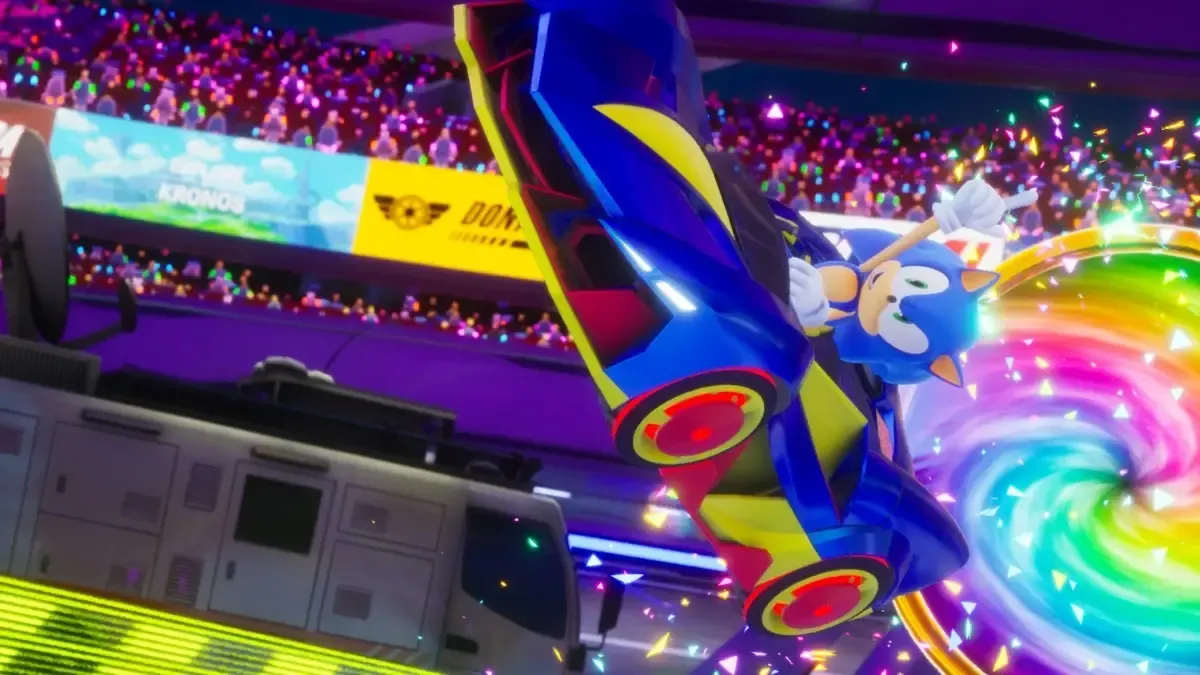
The vehicle transforms into planes and boats depending on what the track requires. Flying feels pretty smooth and straightforward, however, boats feel flatter and less interesting.
The CrossWorlds gimmick
The game’s headline mechanic is the “CrossWorlds” feature. On the second lap of each race, the leader can teleport everyone through a giant golden ring to one of 15 alternate tracks, or a random one. It’s a novelty that spices things up, but the benefit to the leader is minimal and the transition isn’t spectacular.
It also comes back in Grand Prix finales, where you cycle through tracks you’ve already raced, which can feel repetitive. The rival system adds some spice by pitting you against specific foes for bonuses, but overall the CrossWorlds mechanic feels more like a fun shake-up than a game-changer.
Customisation and upgrades that keeps you hooked

The real star of CrossWorlds is the customisation. Every vehicle can be tweaked with parts, perks, and gadgets that actually change how it handles. Early on, something as simple as a perk that helps you recover faster when falling off the track is useful, but as you unlock more, it becomes about stacking stats and refining builds to perfection.
This is where the game outshines rivals. In those games, cosmetic swaps are just for looks and a lot of times, comes in pre-set bundles and parts. In CrossWorlds, builds matter.
For a tinkerer like me, it creates an addictive loop: race to unlock, unlock to upgrade, upgrade to go faster, then repeat. It’s a constant motivation to keep playing, even after hours of back-to-back Grand Prix.
Multiplayer and Time Trials keep things interesting
Multiplayer is also a high. Online races are pure mayhem, while four-player local split-screen makes it a party staple. The Race Park adds team-based twists, like colliding with allies for speed boosts or competing for rings. They’re essentially custom game modes, but they keep the chaos fresh.
Time Trial deserves its own spotlight. It’s where I spent hours experimenting with different builds against my personal bests. Being able to race myself over and over, adjusting perks and vehicle setups until I finally shaved seconds off, felt incredibly rewarding.
Music and crossover content does the job but not the best
The soundtrack honestly could do better though, although not really ugly in itself. It leans heavily on Sonic-themed music, which fits the game’s identity but lacks variety compared to genre rivals. Personally, I didn’t mind, the colourful visuals already give me plenty to focus on, but it’s fair to say the music doesn’t always match the creativity of the tracks. That said, not all tracks are boring, with Sega showcasing tracks from popular Japanese group Creepy Nuts.
Where the game gets exciting is in its content roadmap. Hatsune Miku joins as the first crossover character, with Persona 5’s Joker and Like a Dragon’s Ichiban Kasuga set to follow. These collabs add real flavour, though it’s a shame that many are gated behind a Battle Pass. For a kart racer, that feels restrictive, the kind of content that should reward players naturally through play.
Verdict
Sonic Racing CrossWorlds succeeds because it keeps the core racing simple, fun, and accessible, while giving players endless reasons to come back through customisation and challenges. The tracks are colourful and creative, the multiplayer chaos is a blast, and the tinkering loop of unlocking and upgrading vehicles is addicting in a way few kart racers manage.
It isn’t perfect, the CrossWorlds gimmick is more novelty than necessity, some tracks blend together, and the soundtrack lacks variety. The Battle Pass model also feels like an odd fit. But even with those flaws, the game has kept me coming back again and again, unable to put the controller down.
Sonic Racing: Crossworlds is available on PlayStation 5, PlayStation 4, Xbox Series X|S, Xbox One, Windows PC, and Nintendo Switch. A version for the Nintendo Switch 2 is planned for a later date in 2025. The Standard Edition costs $69.99 USD, and the Digital Deluxe Edition costs $89.99 USD.