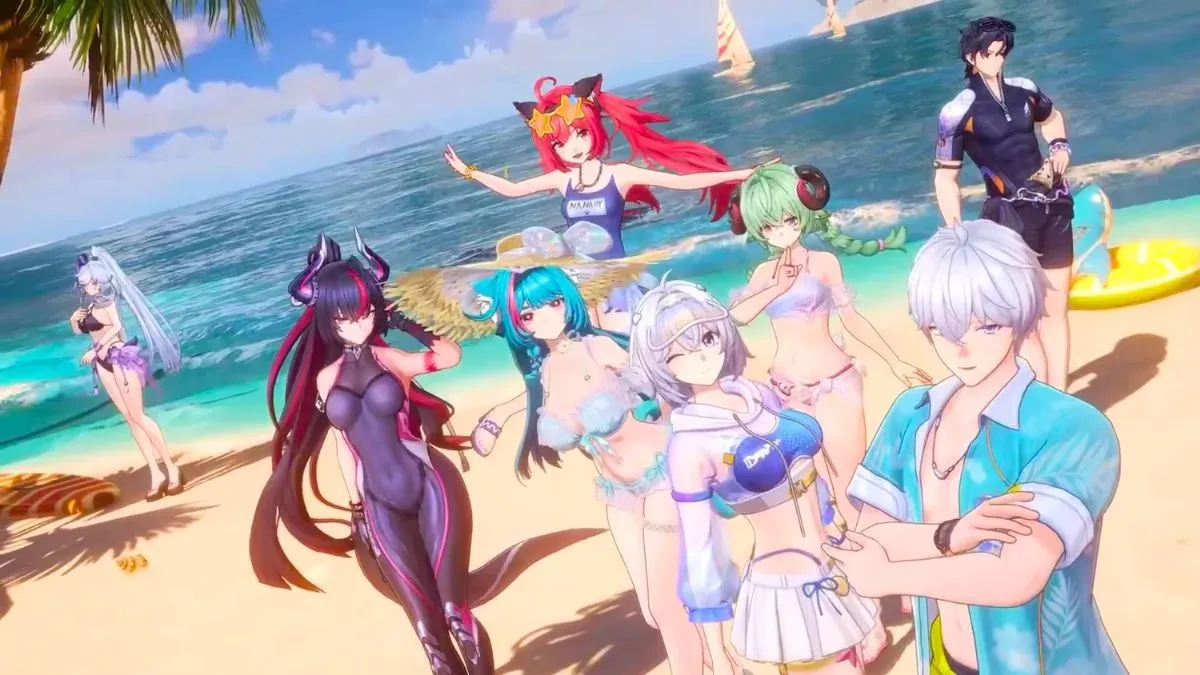
Chinese players found an unexpectedly familiar logo hiding in one of Version 1.3's assets.
Neverness to Everness is facing another round of criticism over its use of generative AI after Chinese players spotted a Doubao watermark left on an in-game image. The artwork, which depicts a seahorse, appeared in Version 1.3 of the supernatural open-world RPG following its release in China on 12 August. Screenshots quickly began circulating among Chinese players before making their way to Reddit and X, with one detail making the source of the image particularly hard to miss: a visible watermark for ByteDance's AI assistant Doubao.
Doubao (豆包) is a generative AI assistant developed by TikTok parent company ByteDance, with tools covering text, image, and video generation, among other functions. Images and videos generated through its free tier carry a visible watermark.
Neverness to Everness (NTE)
Release Date: 29 April, 2026
Platforms: PC, PlayStation 5, PlayStation 5 Pro, iOS, Android, and Mac
Developer: Hotta Studio
Chinese NTE players find Doubao watermark in-game
Bilibili creator Wuxiang Xiaoyugan (五香小鱼干) was among the Chinese players who checked the image themselves, uploading a video showing the seahorse artwork in-game on 17 August. In the video, Wuxiang Xiaoyugan says they initially saw the image shared in a group chat and thought it looked AI-generated. They then logged into NTE to check and found the same asset, complete with the Doubao watermark.
Chinese players roast NTE over the Doubao AI image
A separate Bilibili discussion captured some of the Chinese player reactions, with screenshots of the comments later shared on X.
User Daidai Damowang (带带大魔王) confirmed they had checked the asset themselves: “I just logged in and checked, and it's real.”
Once that was settled, the comments quickly turned to what else Doubao might have been used for behind the scenes. Xuanyuan Xiaopangzhi (轩辕小胖纸) joked that “the code was probably written directly by Doubao,” while Heiyu Yemao (黑羽夜猫) imagined the request behind the seahorse itself: “Doubao, Doubao, help me generate a game asset image of a Purple-crowned Seahorse.”
Then Xuezhixia Xuenaide Mao (雪之下雪乃的猫) decided to skip a few steps and ask for the whole game: “Doubao, Doubao, can you help me generate an open-world anime-style game? Remove the watermark.” The jokes continued from there, with players wondering how many tokens it would take to generate an entire game and taking shots at NTE's development costs.
Back on the original Bilibili video, Wuxiang Xiaoyugan returned with an update the following day. “The official version has already been updated, and the Doubao watermark issue has been fixed,” the creator wrote on 18 August.
NTE has faced questions over its use of generative AI before. Shortly after its April launch, players flagged several suspected AI-generated assets, while VTuber Ironmouse pulled out of sponsored content for the game over AI concerns.
Hotta Studio later acknowledged using AI-assisted tools on “a small number of background and environmental assets”, while saying that the characters, stories, and world in NTE were the work of its artists, writers, and designers. The studio also said it was reworking flagged assets and was “committed to delivering the quality you deserve.” However, Hotta has not commented on the latest controversy.